Siler City, NC
Chatham County · Altitude 598 ft.
History
Siler City is located at 598 feet above sea level in west Chatham County and named after a family of settlers who came from Germany around 1750. Known first as Matthews Cross Roads (after Captain Billy Matthews) at the junction of the Raleigh-Salisbury and Fayetteville-Greensboro plank roads, later with the coming of the CF&YV Samuel Siler was honored when the depot was named Siler’s Station. The post office established in Samuel Siler’s store on July 13, 1880 was named Energy. The name was changed to Siler Station in 1884 and to Siler City in 1886. The town was incorporated March 7, 1887. Read more about the history of this town at the official Siler City web site. This town produces furniture, textiles, processed grain and poultry according to the North Carolina Gazetteer.
By the standards of the line, Siler City’s depot was a modern one. The 1916 ICC valuation recorded an L-shaped Type 3 combination station (Southern Railway print No. 15/219) with its freight room set nearly three feet above the passenger end — and, most tellingly, wired for electric light. In 1916 that put Siler City in select company: only three stations on the entire A&Y had electricity, and the other two were the terminals at Mount Airy and Greensboro. Siler City was the only country depot on the line so equipped. Fittingly for the Chatham County seat, it also anchored the largest industrial cluster on the southern main line short of Sanford — the survey logged dedicated sidings for the Hadley-Peoples Manufacturing Company and the High Point Bending & Chair Company, the Stout Brothers siding just to the south, and the longest passing track in the whole southern segment.
Track Diagram

In 1943, the Siler City yard had a capacity for 54 cars. Today it is a very small part of the NS system. The yard was a typical small yard in the industrial section of town. The currently existing industrial buildings probably did not exist or were differently configured during the A&Y era.
Industries
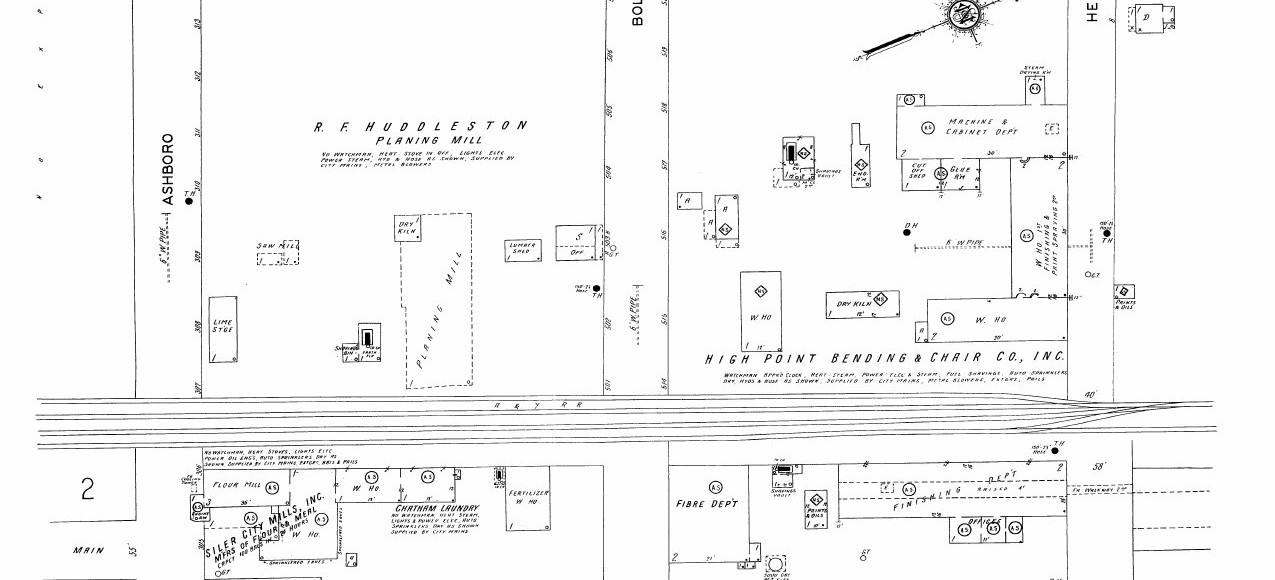
A Southern Railway Shippers Guide from 1916 listed fifteen industries in Siler City using the A&Y for delivering and receiving products by rail (although some may have used the station or team track rather than a dedicated siding). The 1930 Sanborn fire insurance maps confirm several of these and document additional firms operating along the A&Y tracks by that date.
| Industry type | Goods shipped / received | Company name |
|---|---|---|
| brick factory | machine-made bricks | Bray Bros. |
| cotton gin | cotton | Edwards & Lane |
| cotton gin | cotton | Farmers Gin Co. ③ |
| cotton gin | cotton | Lambe Mfg. Co. |
| cotton gin | cotton | T.E. Lane & N.L. Stone ③ |
| cotton mill | yarns, 12s, 16s, and 20s, 2‑ply skeins and tubes | Hadley-Peoples Mfg. Co. |
| flour and grist mill | shipstuff, meal, bran | Siler City Milling Co. (see link below) |
| flour and grist mill | flour, shipstuff, meal | Electric Milling Co. |
| flour mill | flour, meal | Siler City Mills, Inc. ③ |
| furniture factory | chairs, rockers, porch and lawn furniture, brace arms, goose necks, chair stock in rough | High Point Bending & Chair Co. |
| grain and hay dealer | meal and crushings | Siler City Light & Telephone Co. |
| hosiery mill | hosiery | Chatham Hosiery Mills, Inc. ③ |
| ice and coal dealer | ice, coal | Siler City Ice & Coal Co. ③ |
| machine shop | machine work | C.S. Ellis Machine Co. ③ |
| planing mill | pine roofers & building material | Stout Bros. Lumber Co. |
| planing mill and sawmill | lumber, building materials | R.F. Huddleston Planing Mill ③ |
| sash, door & woodworking factory | sash, doors, millwork | Chatham Sash & Door Co., Inc. ③ (in receivership Sept. 1930) |
| sawmill | oak, pine, poplar | H.H. Elder |
| sawmill | oak, pine, poplar | Ed. T. Jordan |
| spoke and handle factory | ax, pick, hammer, canthook handles | D.C. Kidd (P.O. Ore Hill, NC) |
| spoke and handle factory | spoke billets | P.A. Smith (P.O. Kimbolton, NC) |
| steel, iron works & machine shop | general machine work | A.A. Lambe |
| woodworking / bent chair stock | bent chair stock, chairs | Williams-Brower Co., Inc. ③ |
| woodworking factory | rough chair stock | Piedmont Hardwood Co. |
③ Identified from the 1930 Sanborn fire insurance maps; not in the 1916 Southern Railway Shippers Guide. Sources: Southern Railway Shippers Guide, 1916; Sanborn Fire Insurance Maps, Siler City, N.C., Oct. 1930 (Library of Congress).
Odds and Ends
Here I will include any information that is non-railroad in nature that helps provide a hint as to the character of the people and industries who lived and worked in Siler City. I welcome any and all information about this former A&Y community!
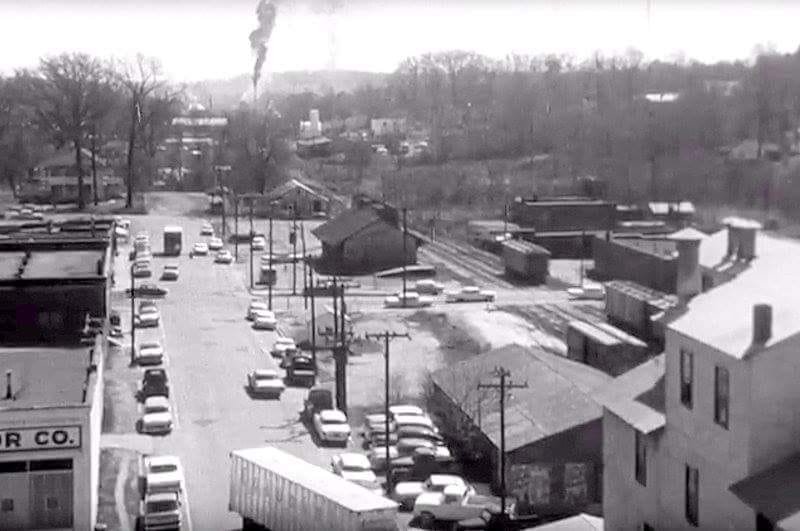
This image was posted on the A&Y Facebook page by Doug Nixon. The date can be guessed from the automobiles. This is likely taken from the Siler City (Chatham) Mills. It shows the original depot in the center.
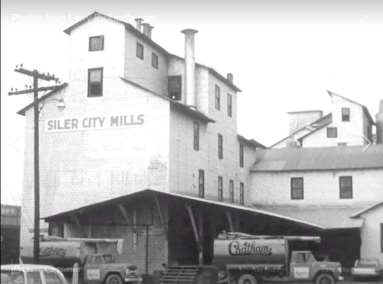
The Siler City Mills was a prominent industry in town. I have linked a PDF by Jerry Stone with historic information about the last years and the fire that destroyed the mills.
I also have a PDF of “The First 75 Years” booklet published by the company.

A greased pig contest photo courtesy of “The Siler City Grit” newspaper circa 1924. Found on eBay.
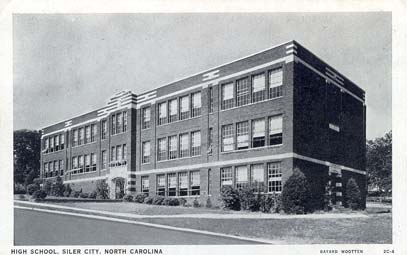
Siler City High School, circa 1939.
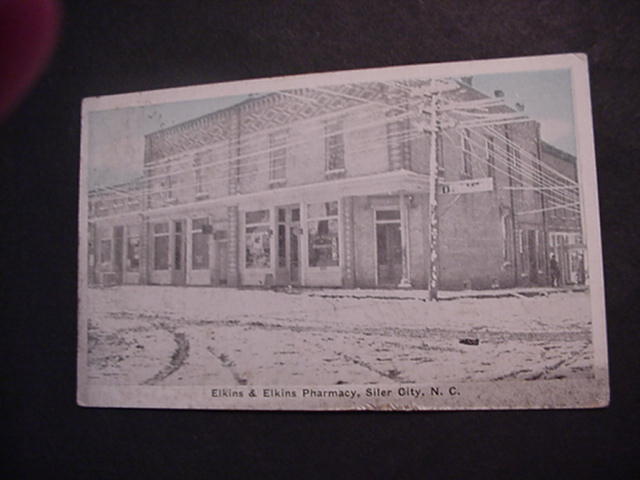
Elkins Pharmacy, Siler City, NC.
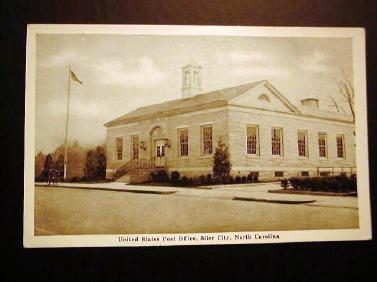
The Siler City Post Office circa 1940.

Siler City Drug Store, circa 1915.
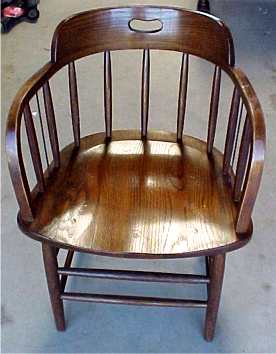
An oak chair from the Boling Chair Company of Siler City, NC.

The only photograph I took here. The image is probably of more interest to N&W historians and NS modelers than to those interested in the A&Y.

Why a soda poster? I found this poster on eBay and the story told by the seller was that POP KOLA was a Coca-Cola® imitation circa WWII that was too close to the real thing — because someone had gotten the actual Coke formula! The lawyers had it out and POP KOLA ceased production. Why is this on the Siler City page? According to the eBay seller, POP KOLA was bottled by Reitz Bottling Company of Siler City, NC! I have now verified this story from another source. However, Jack Allred states that the name of the company was Reitzel Beverage Company. According to Jack, POP KOLA was short lived. The Reitzel’s most popular drink was probably “3 Cent Copper” — it also tasted a lot like Coca Cola. Another product, Gold Dot soda, was also bottled by Reitzel Beverage Company.
More information on Siler City to come. Stay tuned.