Greensboro, NC
History
The Cape Fear & Yadkin Valley Railway reached Greensboro on April 16, 1884, establishing the city as the railroad’s operational center. The CF&YV built a substantial yard with roundhouse, turntable, and shops — along with a wood frame passenger depot that was later converted to freight use after the Southern Railway absorbed the line. When the Southern reorganized the bankrupt CF&YV as the Atlantic & Yadkin in 1899, Greensboro became the A&Y’s headquarters — the only city on the line to hold that distinction.
Rather than rebuild the old CF&YV shop facilities, the A&Y relied on Southern’s Pomona Yard, located just south of the A&Y/Southern grade crossing, along with a Southern Railway coal chute near the downtown Greensboro yards — a 205-foot structure served by three tracks that was wired for electric lights in 1913. Greensboro was where Southern delivered all the leased cars, cabooses, and locomotives that comprised the A&Y roster, and most A&Y trains originated and terminated here. By 1921 Southern maintained all tracks from the A&Y crossing southward — including the engine terminal at Pomona — even before any formal arrangement existed.
The 1916 ICC valuation catalogued a substantial physical plant on the A&Y’s books at Greensboro — a machine shop, boiler room, blacksmith shop, and the racks, paint house, and store houses of a locomotive-servicing complex, the largest single cluster of buildings at any point on the line. Some of the detail is telling. The shops drew steam heat directly from a locomotive boiler kept in the boiler room; several of the locker rooms and shanties were simply the bodies of retired box cars set on piers; and the whole was wired for electric light, which in 1916 made Greensboro one of only two stations on the entire A&Y — the other was Mount Airy — with electricity at all. The same valuation still carried the original Cape Fear & Yadkin Valley main line through town, by then reduced to an inventoried yard track: a physical trace of the railroad the A&Y had grown out of.
When the A&Y entered federal receivership on March 24, 1924, placed under Receivers A. E. Smith and J. W. Fry by the U.S. District Court for the Western District of North Carolina, the new Superintendent Sydnor DeButts estimated it would cost approximately $95,000 to build independent A&Y terminal facilities at Greensboro. The Receivers chose instead to formalize the existing arrangement: a joint use agreement effective May 16, 1924 gave the A&Y joint access to Southern’s tracks and terminal facilities at both Greensboro and Pomona. Southern performed all switching and train assembly for the A&Y at Pomona; the Receivers paid a percentage of engine rental, fuel, and yard labor costs in return. Billing disputes over exactly what percentage applied to which expenses began almost immediately and generated a substantial volume of correspondence throughout the receivership years.
The A&Y’s primary source of revenue was switching industries in Greensboro, particularly along the Furnace Branch — a 2.02-mile line named for an early pig iron furnace that once stood near the junction — which ran toward Proximity Mills and served the Cone family’s textile complex: Proximity Manufacturing, White Oak Cotton Mills, and Revolution Cotton Mills all received coal and raw materials and shipped finished goods over A&Y tracks.
On June 7, 1923, a Southern Railway freight engine (No. 348, working an A&Y freight extra) collided head-on with a Southern Railway yard engine (No. 517) at Battleground Hill in Greensboro, within yard limits, killing Track Supervisor John H. Medearis and the yard engine’s engineman. See Safety & Train Orders for the ICC accident report.
By the late 1930s the A&Y was running only six regular trains daily and barely covering its fixed charges. Passenger service ended May 1, 1939, at 12:01 a.m. — ending the last use of the Union Station leasehold. That same year Southern Railway removed the downtown Greensboro coal chute from the yards; locomotive coaling consolidated at Pomona. From 1940 onward, freight switching was the A&Y’s sole source of revenue.
By the 1950s the A&Y’s Greensboro local was known informally as “the Sears Man” for its regular service to the Sears distribution center on Lawndale Avenue — a nickname that surfaces in a 1954 Brotherhood of Locomotive Engineers safety complaint about operations at Pomona Yard.
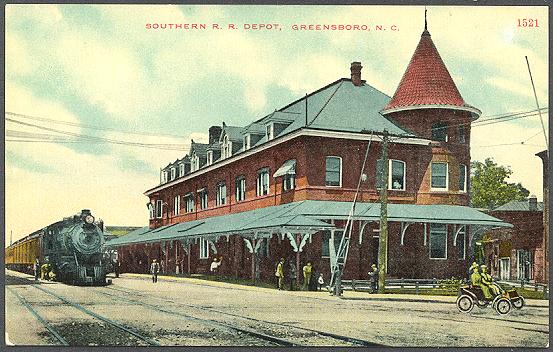
Colorized photo postcard of the Southern Railway station in Greensboro, ca. 1908 — the pre-Galyon era station. The A&Y did not build a separate passenger facility; it held a leasehold interest in the Greensboro Union Station, a property right inherited from the CF&YV and formalized in the 1899 deed that created the A&Y.
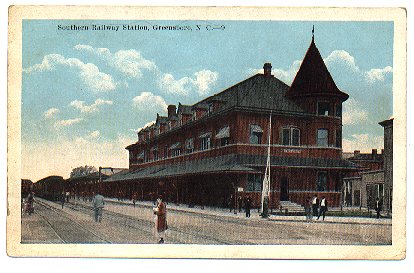
This colorized postcard is labeled ca. 1930 but appears to depict the same pre-Galyon station as the 1908 image above — the postcard may have been printed from an older negative, or its date is simply inaccurate. Colorized photo postcard, ca. 1930 (date uncertain).
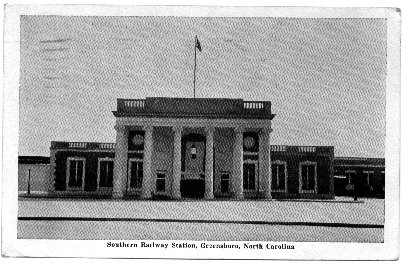
The J. Douglas Galyon Depot, opened in 1927. Southern Railway built the 65,000 sq. ft. columned structure to replace the older station; it served both mainline passengers and the A&Y through the end of passenger operations in 1939.
Track Diagram
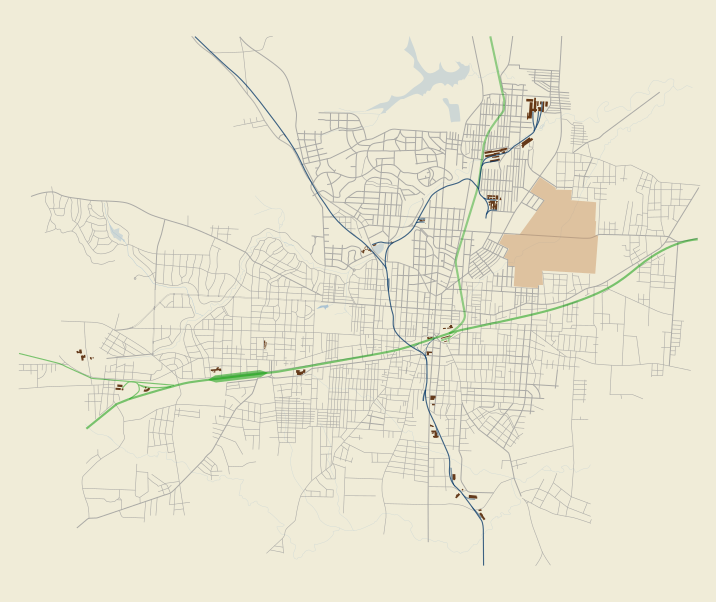

This diagram is only the overview of the A&Y – Southern junction and tracks from the ICC Valuation blueprints. More detailed maps are available, but I have not had a chance to clean them and stitch them together.

This diagram includes the depot.

This diagram does not give much detail, but it shows the relative geometry of the A&Y’s furnace branch in Greensboro relative to the Southern’s mainline.

This diagram shows the Southern Power Plant in Greensboro.

This diagram covers the entrance to Proximity Mills, a textile mill.
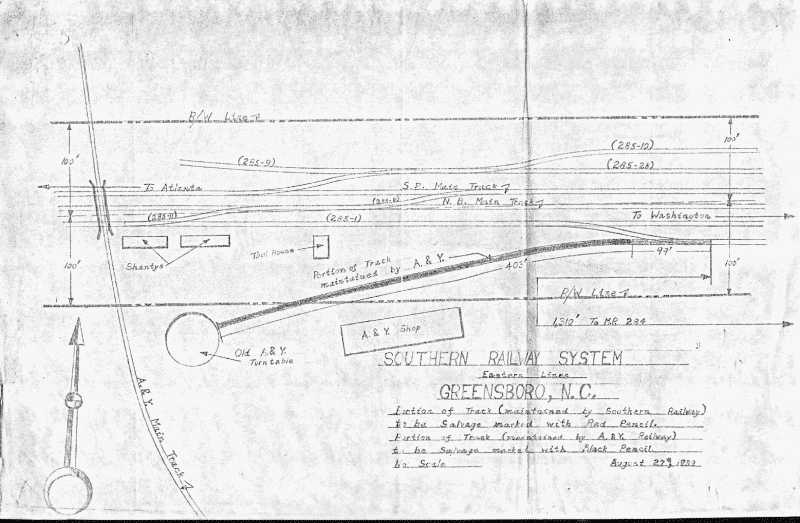
Here is a view of the yard tracks from a Southern Railway document showing where the A&Y tracks were to be removed.
Document is from the collection of Marvin Black (R.I.P.).
Industries
A Southern Railway Shippers Guide from 1916 indicates the following industries in addition to LCL shipments, passengers, and mail were located in Greensboro and used either the A&Y or the Southern for delivering and receiving products by rail (although some may have used the station or team track rather than having a dedicated siding). I will add other industries as I receive information about them:
| Industry | Goods Shipped/Rec’d | Company Name |
|---|---|---|
| agricultural manufacturer | threshing machines | J. I. Case Threshing Machine Co. |
| brick factory | bricks | Cunningham Brick Co. |
| chemicals | rendering byproducts | Carolina By-products |
| cigar factory | cigars | W. F. Clegg |
| cigar factory | cigars | Guilford Cigar Co. |
| cigar factory | cigars | T. A. Lyon |
| cigar factory | cigars | O. El Rees Cigar Co. |
| cigar factory | cigars | E. J. & A. G. Stafford |
| cotton mill | Indigo Blue Denims | Proximity Manufacturing Co. |
| cotton mill | Indigo Printed Drills and Denims | Proximity Print Works |
| cotton mill | Indigo Blue Denims | White Oak Cotton Mills |
| cotton mill | Cotton and Canton Flannels | Revolution Cotton Mills |
| cotton mill | Grey Cloths | Pomona Mills, Inc. |
| fertilizer factory | fertilizer | Armour Fertilizer Mfg. Co. |
| flour and grist mill | roller mill | W. A. Watson & Co. (Greensboro Roller Mills) |
| furniture factory | furniture | Patterson-Kiser Seat Co. |
| furniture factory | furniture | Standard Table Co. |
| furniture factory | furniture | Sterling Furniture Co. |
| manufacturing | terra cotta pipe | Pomona Pipe Products |
| marble tile factory | marble and tile | McClamrock Marble & Tile Co. |
| mattress, pillow, bedding factory | matresses | Caveness Mattress Co. |
| mills | flour | Wafco complex |
| ornamental metal works | miscellaneous | J. D. Wilkins |
| planing mill | miscellaneous | Cape Fear Mfg. Co. |
| shingle mill | shingles | Cape Fear Mfg. Co. |
| steel | steel | Carolina Steel |
| steel | steel fabricated parts | Carolina Steel |
| woodworking factory | miscellaneous | South Atlantic Lumber Co. |
| woodworking factory | miscellaneous | H. J. Thurman Lumber Co. |
| woodworking factory | miscellaneous | Guilford Lumber & Mfg. Co. |
| distribution | merchandise | Sears distribution center on Lawndale Ave |
| feed & seed | fertilizer | Agrico |
| feed & seed | fertilizer | USS Agrichem |
| manufacturing | concrete | |
| textiles | cotton | Cone Mills |
| textiles | clothing | Cone Mills |
Odds and Ends
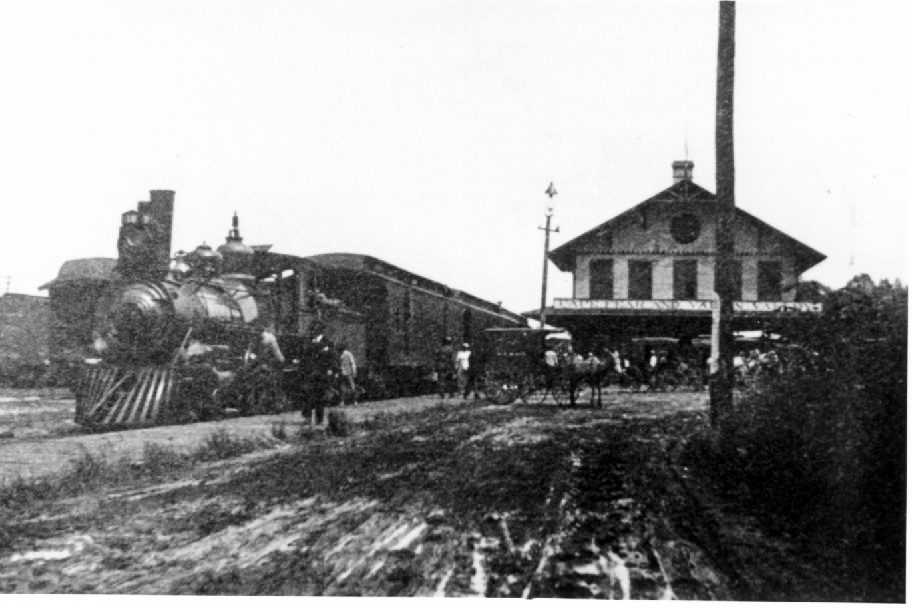
Here is the Greensboro station in the Cape Fear & Yadkin Valley days.
Photographer unknown, image provided by Jim McGhee.

Proximity Mills was a textile factory owned by the Proximity Manufacturing Company run by the Cone family. This colorized photo postcard was circa 1907–1915.

This is a photo postcard image of the White Oak cotton mills and company homes. White Oak was owned by the Proximity Manufacturing Company also. A lot of early large industries tried to keep workers sufficiently satisfied so that they would not attempt to unionize. In many cases, that included homes, schools, play grounds, garden plots, and other amenities.
The mill village was laid out and constructed by the company around 1920 to serve the White Oak textile mill, a half-mile to the east. It was organized around a small isolated grid of streets which do not continue past 11th Street and 12th Street at the south, 14th Street and 16th Street at the north, North Church Street at the west, and the former Southern Railway tracks at the east. These amenities worked in many cases, keeping the workers happy. Being company supplied though, if profits were down these amenities could disappear or funding for them could be significantly reduced.
Learn more about the White Oak New Town Historic District here. Here’s another page on the Cone Mill Village.

While not terrifically helpful to modelers, here is an aerial overview of the city circa 1890. You can see the CF&YV (nee A&Y) track crossing the Southern. The CF&YV start at the middle left of the image where they would continue to the left and up (railroad west) heading to Mt. Airy. From the middle left, the track comes down and to the right where it goes under the Southern mainline (angling from top right corner to just above the R in Greensboro) and curves a bit before heading off the lower right hand side (railroad east) towards Pleasant Garden and on to Sanford.

Here is a shot of the Greensboro underpass of the Southern Railway. The track in the foreground was the Southern’s heading up and away towards its mainline which is on that overpass running from right to left. The A&Y mainline is the second track heading under the Southern’s line and away north to Mount Airy.

Here is the junction looking south down the A&Y in the direction towards Sanford.