Construction Complete
The CF&YV spans North Carolina — from Wilmington to the Surry County foothills
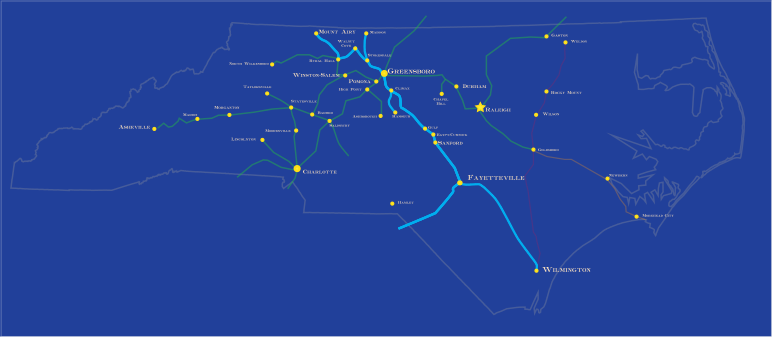
A Railroad Built in Pieces
The CF&YV’s construction program unfolded across eleven years and three distinct bond divisions, each with its own investors, its own mortgage, and its own strategic logic. The three divisions were built in the order that made financial sense — not the order the original charter had projected.
The A Division came first. The segment from Sanford through Greensboro down to Fayetteville, together with the Bennettsville branch operated through the South Carolina Pacific Railway, reached completion in 1884. This was the railroad’s strongest commercial corridor: the coalfields around Cumnock were producing freight, Fayetteville was an established river market, and the Pee Dee tobacco and cotton country around Bennettsville offered agricultural carloadings. The A Division worked from day one. The Spencer legal history called its traffic "lucrative."
The B Division — 71 miles from Greensboro north through Winston-Salem to Mount Airy — opened on June 11, 1888. It had been built largely because the municipalities along the route had subscribed county and town bonds to attract the railroad. The hoped-for through connection to the Norfolk & Western at the Virginia state line was never achieved, though a connection via the Roanoke Southern eventually provided some interchange traffic. Local business was sparse. The Spencer history called the B Division "a disastrous enterprise" that "yielded practically no local business."
The C Division — 83 miles from Fayetteville south to Wilmington — completed the main line on February 17, 1890. Its construction had been urged and partly funded by Wilmington commercial interests, who contributed $150,000 in city bonds to make it happen. The vision of an ocean-to-mountains trunk line was compelling on paper. The traffic reality was not.
The Completed System
By February 1890 the CF&YV was physically complete. The main line stretched 248 miles from Wilmington on the Cape Fear River north to Mount Airy in the Surry County foothills. The Bennettsville branch extended 57 miles south from Fayetteville into South Carolina. Five branch lines — the Factory/Ramseur branch serving the textile mills at Ramseur (18.74 miles), the Madison branch off Stokesdale (11.39 miles), the Granite branch from Mount Airy to Flat Rock (2.02 miles), the Furnace branch serving Proximity Mills at Greensboro (1.00 mile), and the Gulf/Bluff Quarry branch (1.10 miles) — added another 33 miles. Total system: 338 miles of main track, 364 miles including sidings.
On a map it made a compelling diagonal slash across the state’s piedmont. Wilmington was on the Atlantic coast; Mount Airy sat at the southern edge of the Blue Ridge. Promotional materials called the CF&YV an ocean-to-mountains railroad, and in a compressed sense it was — the mountains themselves were somewhere beyond Mount Airy, where the original charter had always pointed, and where the rails never reached.
The 1889 Prospectus: The Railroad’s Own Voice
In 1889, as the C Division neared completion, the CF&YV published a prospectus describing the railroad and the regions it served. The document speaks for itself as a piece of Gilded Age promotional writing — confident, expansive, and attentive to the agricultural and industrial character of the piedmont communities the railroad was now binding together.
The uninterrupted progress of the Cape Fear and Yadkin Valley Railway, and its unrivaled prosperity and steadily increasing traffic since the granting of its present charter by the General Assembly of 1879, were only to be expected in the full development and completion of a railway system which occupied the minds of progressive and thoughtful men even as far back as the earlier days of the present century. This system embodied the great ulterior object of opening to the markets of the world the rich territory of the Upper Yadkin Valley by connection with Fayetteville as the head of navigation on the Cape Fear River. But inherent in the Cape Fear and Yadkin Valley system was the very life of North Carolina’s internal improvement — again and again to revive and make itself felt until the time was ripe for the full accomplishment of the great and comprehensive design.
Simultaneously the work of construction was pushed westward, trains were running into the city of Greensboro on the day of the annual meeting of stockholders in 1884, and early in autumn of the same year the southern extension tapped the Carolina Central Railroad at Shoe Heel (now Maxton), in Robeson County. But the green hills of Piedmont were now just in sight, while the stalwart mountaineers of the Blue Ridge were waiting with eager eye and heart intent for the advent of this agent of civilization and development. With every mile of grading and construction the difficulties of engineering were multiplied; but there was little pause in the work of extension, and very soon the road wound its way through the suburbs of Greensboro westward. On the 20th of June, 1888, excursion trains carried thousands of people from every point along the line of the Cape Fear and Yadkin Valley Railway to participate in the ceremonies incident to the celebration of Mt. Airy’s railroad connection with the great outer world — the beautiful village hiding under the shadow of the towering chain of the Blue Ridge.
Not one other railway enterprise has discredited the wisdom, weakened the importance, or proved a serious obstacle to the completion of the Cape Fear and Yadkin Valley Railway, which — crossing the chief water-ways of the State and forming a direct line through some of the finest region of the three geological divisions of North Carolina — bisects it from northwest to southeast, aiming to make final connection by the shortest route with the great railway highway at Cincinnati, and combining finally that most admirable feature of railroading which reaches out and penetrates the undeveloped back country, with its own great seaport for an outlet. Lastly, it is note-worthy that the increase of business of the Cape Fear and Yadkin Valley Railway has kept pace with every mile of road built. No station along the line has failed to swell the receipts; no branch has proven unremunerative for the outlay; and the reports at every stockholders’ meeting demonstrate a largely augmenting volume of business.
“A wealth of riches rather than a poverty of resources” meets the compiler of the great and diversified resources developed by the Cape Fear and Yadkin Valley Railway. Judicious investment of capital in manufacturing enterprises for the utilization of the varied resources of this favored land will make bustling cities of the towns, and thriving towns of the villages and hamlets which dot the line of road from border to border of the State; immigration will bring an industrious population to augment the wealth and producing power of thriving communities; and the near future will bring the realization of the long-cherished dream of the completion of the North Carolina Cape Fear and Yadkin Valley System.
— The Cape Fear and Yadkin Valley Railway: Its Origin, Construction, Connections, and Extensions (Philadelphia: Allen, Lane & Scott, 1889), pp. 1–3, 45. Text proofed and reformatted by David M. Bott, PhD. Read the full document · Download PDF
Achievement and Overreach
The completion of the C Division in 1890 was a genuine achievement. The railroad that had taken thirty years to fully authorize and eleven years to build was at last a coherent system. It connected Wilmington’s port commerce with the tobacco and cotton of the Pee Dee, the coalfields of the Deep River, the textile mills of the central piedmont, the granite quarries around Mount Airy, and the agricultural trade of the Yadkin Valley counties.
But the capital structure beneath that achievement was fragile from the start. The A Division bonds, issued first and secured on the profitable Greensboro-to-Bennettsville corridor, were held largely by New York investors. The B and C Division bonds, issued later to build lines that produced little traffic, were concentrated with Baltimore investors. The branch lines had been funded by a separate Consolidated Mortgage of $1,868,000, all taken up by the North State Improvement Company. When the April 1890 coupon on those Consolidated bonds came due, it was not paid. The railroad had just finished building its most ambitious division and was already missing payments on another piece of its debt.
The Panic of 1893 would expose the full extent of the problem. The A Division’s "lucrative traffic" was not enough to carry the weight of the B and C divisions’ debt and thin revenues. Default on the First Gold Mortgage came December 1, 1893, and a receiver was appointed. The CF&YV that had taken so long to build would spend the next six years in the hands of courts, committees, and competing creditor groups before it was finally auctioned off — and the story of what emerged from that auction is the story of the Atlantic & Yadkin Railway.