A History of the A&Y, Its Predecessors, and Some Successors
Use the date-nail strip above or the sidebar links to navigate to individual eras. Click any image to open a full-size version in a separate window.
The Atlantic & Yadkin Railway was like a bubble that formed in 1899 and popped in 1950. Like a bubble, it was shaped by the materials available and the currents of force that led to its formation. If the bubble had formed of glycerin it may have popped much sooner, like the Mount Airy & Eastern. If made of lava, it may have cooled and solidified, still present today like the Deep River neighbor, the Atlantic & Western. The A&Y however was formed like a bubble of glass, liquid at first, slowly cooling and solidifying, but in the end, fragile and broken only into shards that somewhat reflect the shape, but only as an echo of what once was.
I wish to share what I’ve learned about the materials and forces that shaped the A&Y, gave it a solid 50 years of life as an operating transportation system, and eventually caused it to disappear into shards of abandoned right-of-way and still operating railroads with other names. The A&Y had predecessors dating back to the 1850s. It started as a clever corporate shell game that became just one more part of the amalgam that was the Southern Railway System. Then due to similar long term financial currents that tore apart its origin, it was operated with a plucky independence for almost two and a half decades. Then, due to those same financial currents, it was finally absorbed by the Southern. This absorption was again operational, but it was also legal. The bonds were paid and corporate simplification goals as the Southern sought a singular modern identity erased the name from the ledgers. Even the physical remains, in the following decades, had parts removed and parts spun off from the corporate successor to the Southern as the Yadkin Valley Railroad. And today, talks are in place for the corporate successor to be merged. In a long ago advertisement it was said "the railroads never sleep." Neither does history. These pages give you a glance into the stream of history where the bubble of the A&Y formed, was carried along, and was eventually swept away.
Let’s begin with the origins. Understanding the history of the predecessors explains a lot about the A&Y’s existence. There is much more available from others on how the former A&Y rails were removed or continue to operate under the Southern and its successor companies, so coverage after 1950 will be brief here.
The story here includes images from my slide presentations made for a number of groups, including the Greensboro Chapter of the National Railway Historical Society, the Carolina Railroad Prototype Modelers (RPM), and a zoom meet for a Pre-Depression Era modelers group (also RPM focused). Some images are too large to present in mobile device browsers. So I suggest you try clicking on the image to see if it opens to a full-size version in a separate browser window to allow you to view the detail. With AI support, I was able to code the maps I created in Adobe Illustrator in a scalable SVG format that can be zoomed on any platform with precision.
1852–1860 — Origins: The Western Railroad
The rails began as part of the Western Railroad, chartered on February 14, 1852, as a way to move coal from the mines at the Deep River near Egypt (later Cumnock) through Sanford to Fayetteville on the Cape Fear River.
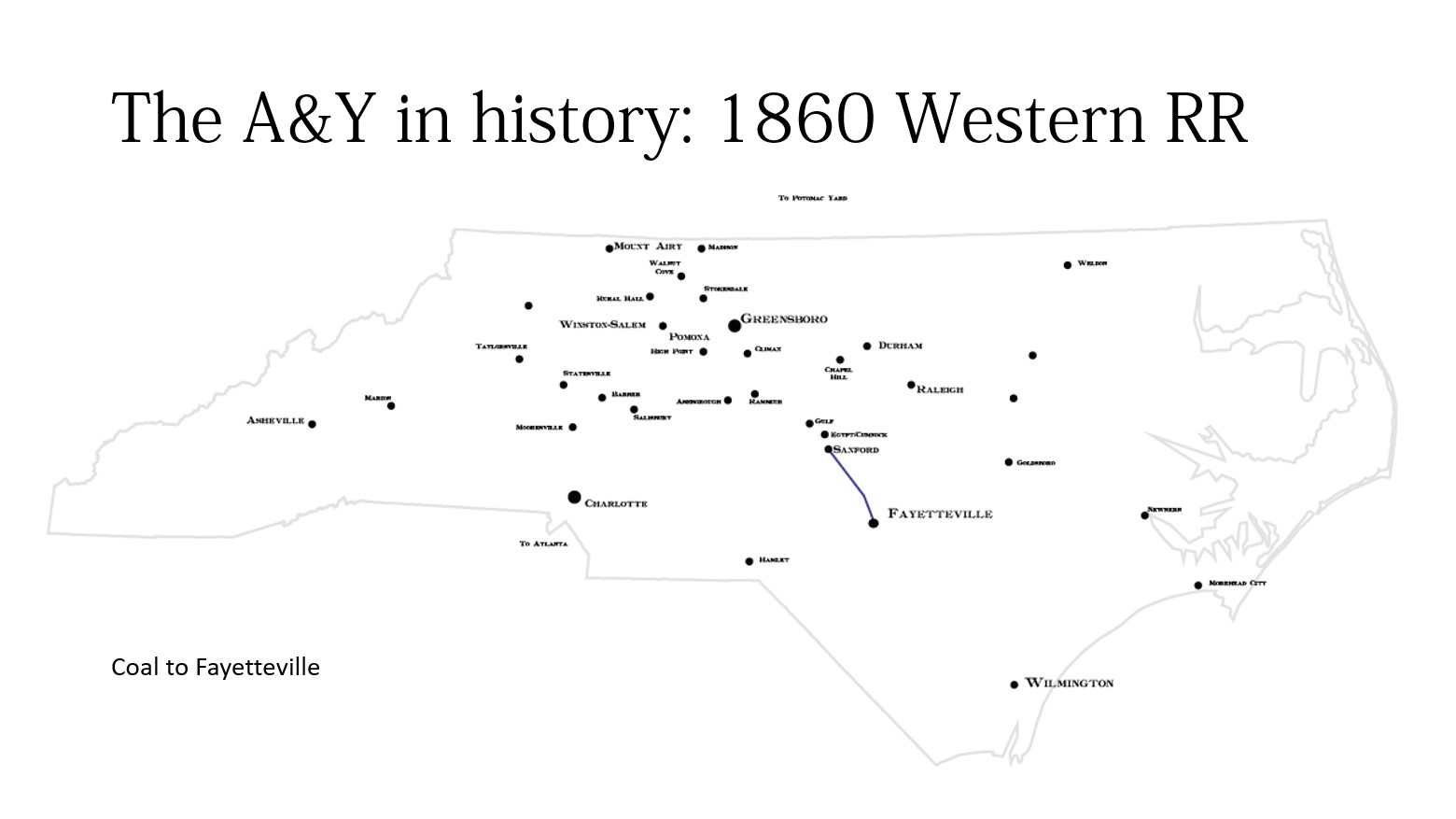
The ultimate vision of investors and promoters was a line stretching northwest to the Ohio River and southeast to the ocean. The promoters worked the NC legislature and investors to get approval and funding to build that line.
1867 — First Extension Authority
The Western Railroad got authorization to extend to the North Carolina state line near Mount Airy. Nothing in the way of actual construction came of it. There was considerable litigation around mortgages for any railroad north of the coal mines.
1871–1879 — Charters, Consolidation, and the CF&YV
In 1871, the Western Railroad also got authorization to build from Fayetteville towards South Carolina. Up north, a Mount Airy and Central Railroad was chartered to permit a narrow gauge road from Mount Airy to some point on the North Carolina Central — but nothing was done with this charter. In 1877, the authority was expanded under the Mount Airy Railroad Company to allow a railroad from Mount Airy to Greensboro as well as branches as it saw fit. On February 11, 1879, the charter was amended again and now the line would begin in Ore Knob (to move copper from Asheboro) through Mount Airy to Greensboro. The company was renamed the Mount Airy & Ore Knob Railroad. Again, no track was laid, but the legal rights and franchises were a value to investors.
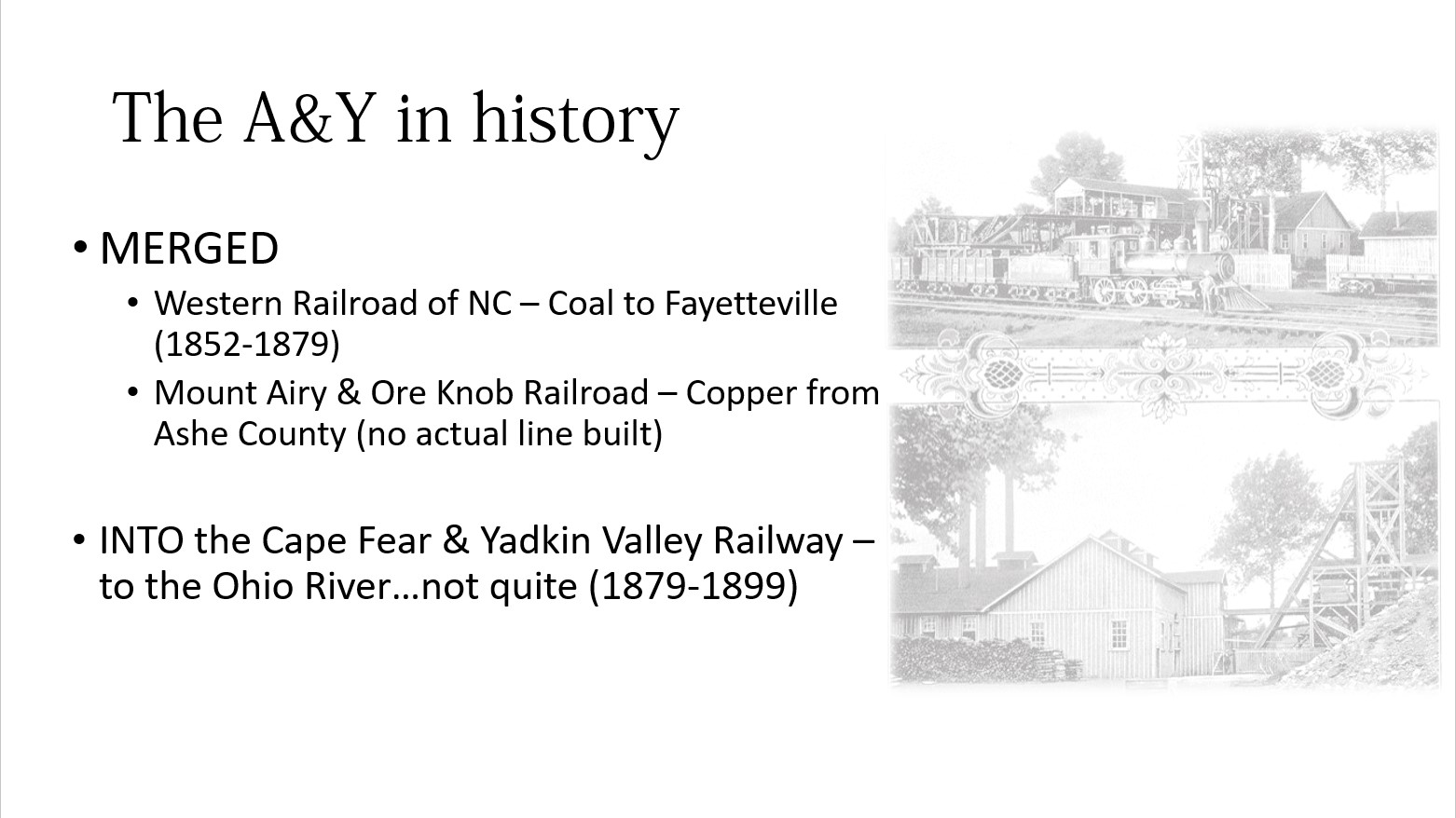
It isn’t clear from available sources who the principal investors were in each company, or whether they were working together or at cross purposes. However, fourteen days later on February 25, 1879, the Western Railroad was reorganized by the legislature. Since it was still authorized to build through Greensboro to Mount Airy, the new legislation allowed the two railroad companies with overlapping authority to be consolidated under the new name Cape Fear & Yadkin Valley Railway.
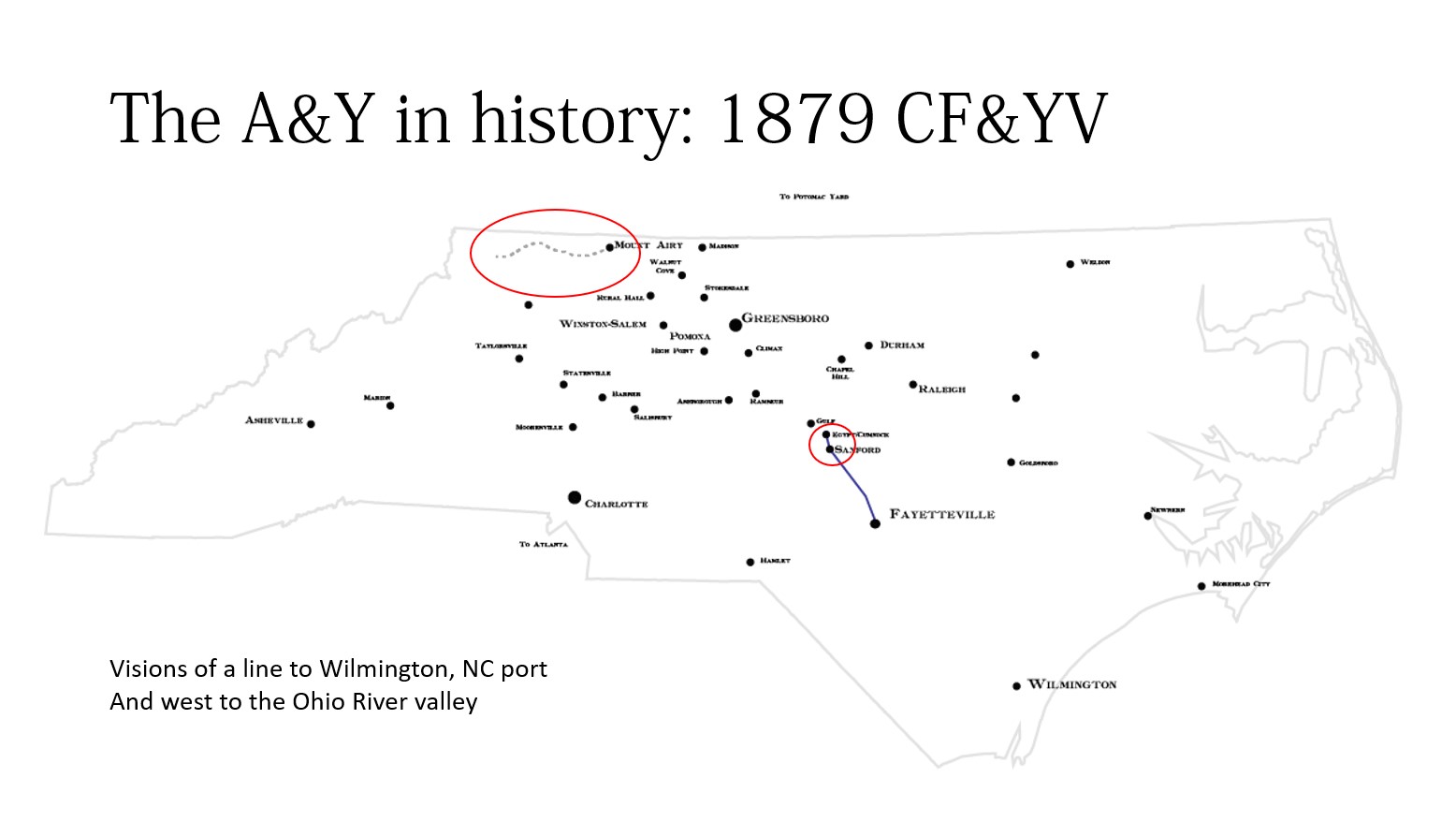
The litigation over mortgages was mostly settled so that construction could proceed. Pragmatically, the Western Railroad had been trying to extend north and at least link up with the North Carolina Railroad somewhere near Greensboro. The rest of the areas to the north had little development and few goods to make a line profitable. The vision motivating the state legislature was a link to the Ohio River trade while developing the rural areas from Asheboro through Mount Airy to Greensboro. The branch to Bennettsville, South Carolina — authorized for the Western Railroad in 1871 — was thrown into this consolidation to link up the existing Western Railroad with the Fayetteville and Florence Railroad Company (authorized by South Carolina’s legislature to build to the state line; it had 36 miles graded but no operational railroad constructed). The Cape Fear & Yadkin Valley Railway linked all these ideas into a line that would reach across the state and move goods — hopefully — to Fayetteville.
1883–1890 — Construction: The A, B, and C Divisions
The state of North Carolina sold its interests in the CF&YV to the North State Improvement Company in April 1883, after considering bids from private firms since 1881. The legislative act provided incentives to complete construction to Mount Airy within four years, and to construct branches to Franklinsville in Randolph County and from Walnut Cove to Danbury in Stokes County.
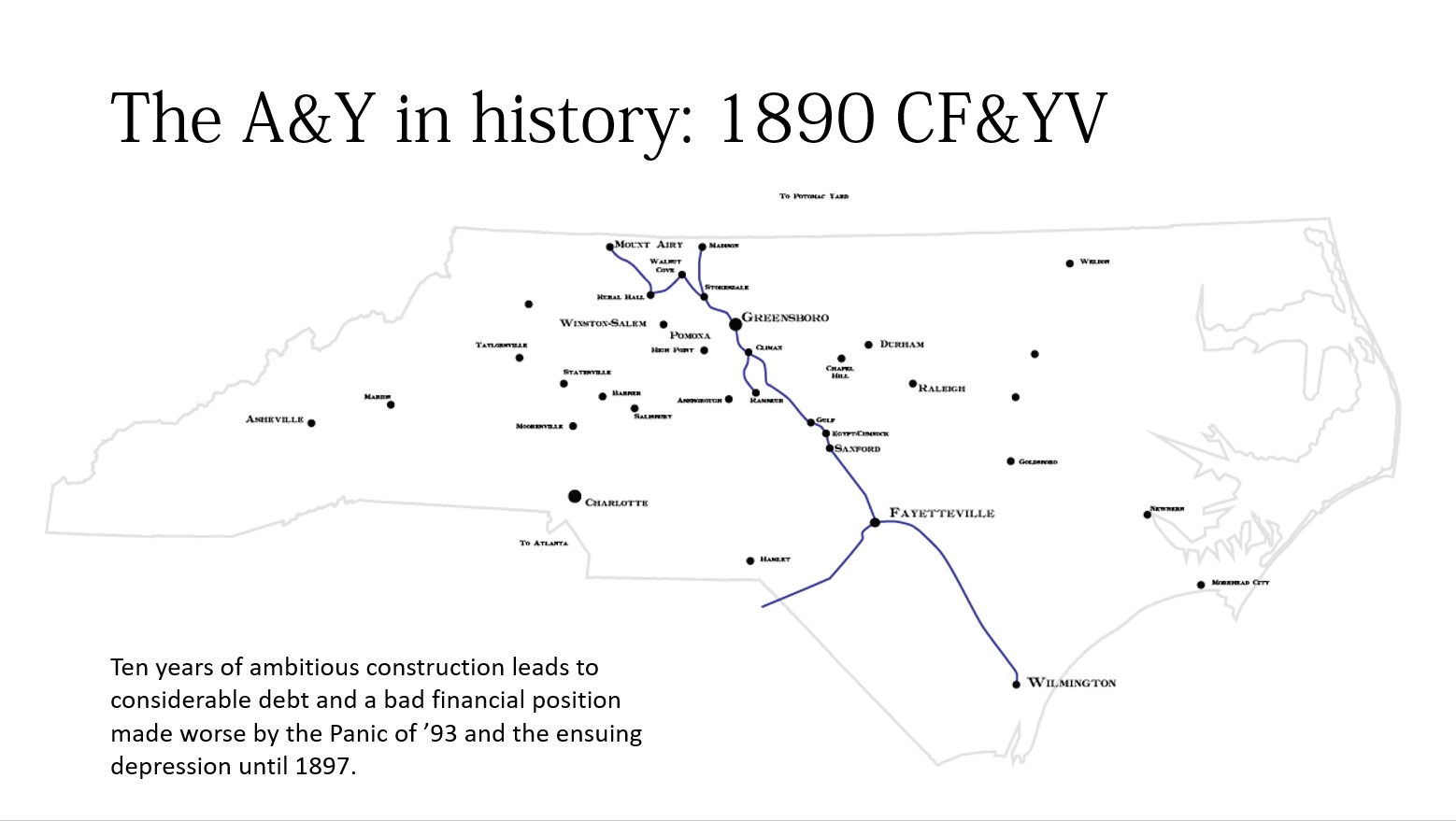
Although the CF&YV investors extended the former Western Railroad towards Greensboro, they immediately constructed the line to Fayetteville first — not to Mount Airy. Soon after taking over the state’s interest, the North State Improvement Company completed a contract with the (reorganized and renamed) South Carolina & Pacific Railway Company in 1883. That branch, completed in 1884, along with the line from Sanford to Greensboro was together termed the "A Division" of the CF&YV. The company was prioritizing available goods and money, which made good business sense.
The investors to the north of Greensboro were not happy and lobbied for work to commence in their direction while promising to subscribe to bonds that funded construction their way. Simultaneously, a new group of municipalities pledged financial support and lobbied the state legislature for an extension to the port of Wilmington. Given the in-state port versus the Bennettsville destination on the Pee Dee River in SC, the NC legislature favored the Wilmington investors’ plan.
The priorities of the North State Improvement Company and the CF&YV directors are evident in their labeling: the extension from Greensboro to Mount Airy became the "B Division" and the extension from Fayetteville to Wilmington the "C Division."
All this construction required new bond issues, each tied to a division. The A bonds (first issued) gave priority liens to the Greensboro-to-Bennettsville line with secondary liens on the B and C divisions. The B bonds put first liens on the B Division with secondary liens on A and C. The C bonds put first liens on the Fayetteville-to-Wilmington line with secondary liens on the others. The A Division was completed first in 1884. The B Division — 69 miles from Greensboro to Mount Airy — was completed in 1888. The C Division — 83 miles from Fayetteville to Wilmington — was completed in 1890.
The lobbying wasn’t finished. In 1889, another round of bonds funded the Ramseur (Factory) Branch, the Madison branch, the Granite branch (Mount Airy to Flat Rock), the Gulf Branch (to Cape Fear Bluff), the Furnace Branch (in Greensboro, named for the pig iron furnace there), and the Aldrich Quarry Branch (from Sanford). Besides those constructed, the old goal of an Ohio River link was still being advocated — this time via an extension from Mount Airy to a proposed extension of the Norfolk & Western from the New River or Cripple Creek coal district in Virginia. By 1890, the CF&YV was mostly constructed, but heavily in debt.
1891–1893 — Decline and Panic
The B and C divisions did not contribute sufficient traffic. While the CF&YV connected with the N&W’s Roanoke Southern line at Walnut Cove, this was not a productive through route and little if any through traffic was generated as the promoters had hoped. The first years after construction showed the CF&YV operating at a loss, despite the profitable A Division.
Amid a financial panic in 1893 that resulted from similar overbuilt railroads and with causes (e.g., gold/silver debates, shrinking foreign investments) outside the scope of this history, a desperate debt restructuring was attempted to stave off defaulting on the bonds — issuing new five-percent, 50-year bonds and extending the franchises from their original 1900 endpoint to 1999. The panic of 1893 signaled a depression that lasted until 1897, almost as long as the CF&YV.
1894–1899 — Foreclosure, Reorganization, and the Birth of the A&Y
The debt restructuring efforts failed. Foreclosure with an appointed receiver occurred in 1894. In 1895, the major investors were permitted to form two reorganization committees — the New York and the Baltimore Committees. Negotiations dragged on for two years. In 1897, a formal decree of foreclosure and sale was announced, but re-hearings were requested, with the New York Reorganizing Committee appealing all the way to the U.S. Supreme Court.
The New York Reorganization Committee held bonds and business interest in the A Division and wanted the CF&YV sold by division or in parts, so they could buy at auction and control the profitable part without being dragged down by the B and C divisions. The Baltimore Reorganizing Committee represented later investors who had stakes mostly in the B and C divisions — if the railroad were not sold as a whole, those divisions were unlikely to be profitable, and the investors would lose everything. The state of NC favored the Baltimore Committee’s plan, wanting to preserve east-west rail access across the state.
In November 1898, the New York Committee’s appeal was dismissed by consent of all parties, who had finally reached agreement. In December 1898, the CF&YV was auctioned off. On January 13, 1899, the sale for $3.125 million was certified and all the properties conveyed to the winning bidders, representing the Wilmington & Weldon Railroad (soon to become the Atlantic Coast Line). But this was not the end of the story.
While the sale conveyed the whole to the purchasers, the charter allowed for a new company to be organized — and this new company could sell or merge itself however it saw fit. So before the end of January, a new company, the Atlantic & Yadkin Railway, was organized and all the properties of the CF&YV were deeded to it. This clever legal end run helped divide the former CF&YV, but into two sections with viable futures, rather than the three divisions with uneven ones.
On February 23, 1899, the North Carolina legislature confirmed the reorganization and formation of the A&Y. The following day, the Wilmington and Weldon procured an Act in NC allowing the company to "consolidate, merge, sell or lease its railroad in whole or in part with or to the Wilmington and Weldon Railroad Company" to create the Atlantic Coast Line. The governor and legislature may not have realized this language also applied to the recently acquired A&Y.
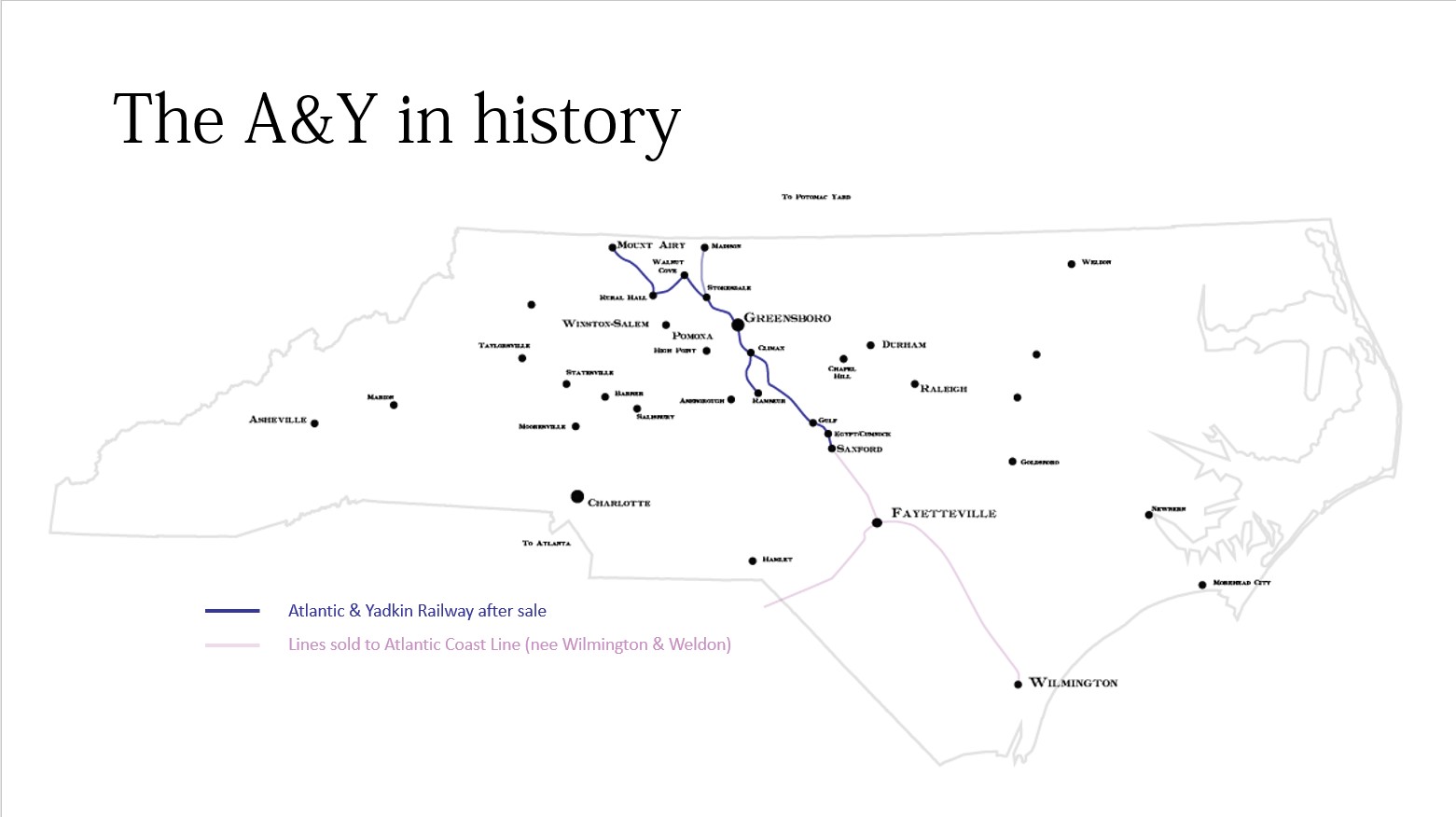
By May 13, 1899 — only four months after the sale was certified — the A&Y partitioned itself 100 feet west of the Seaboard Air Line crossing in Sanford, effectively splitting the CF&YV in half.
In the same process, the A&Y sold the line from Sanford to Wilmington plus the Bennettsville branch (from Fayetteville to the state line, and the lease of the railroad in SC), the Aldrich Quarry branch, and one half the rolling stock of the former CF&YV to the nascent ACL. The former CF&YV was neatly divided with part of the A Division along with part of the C Division in one half, and the rest of the A Division and the B Division with most branches in the other.
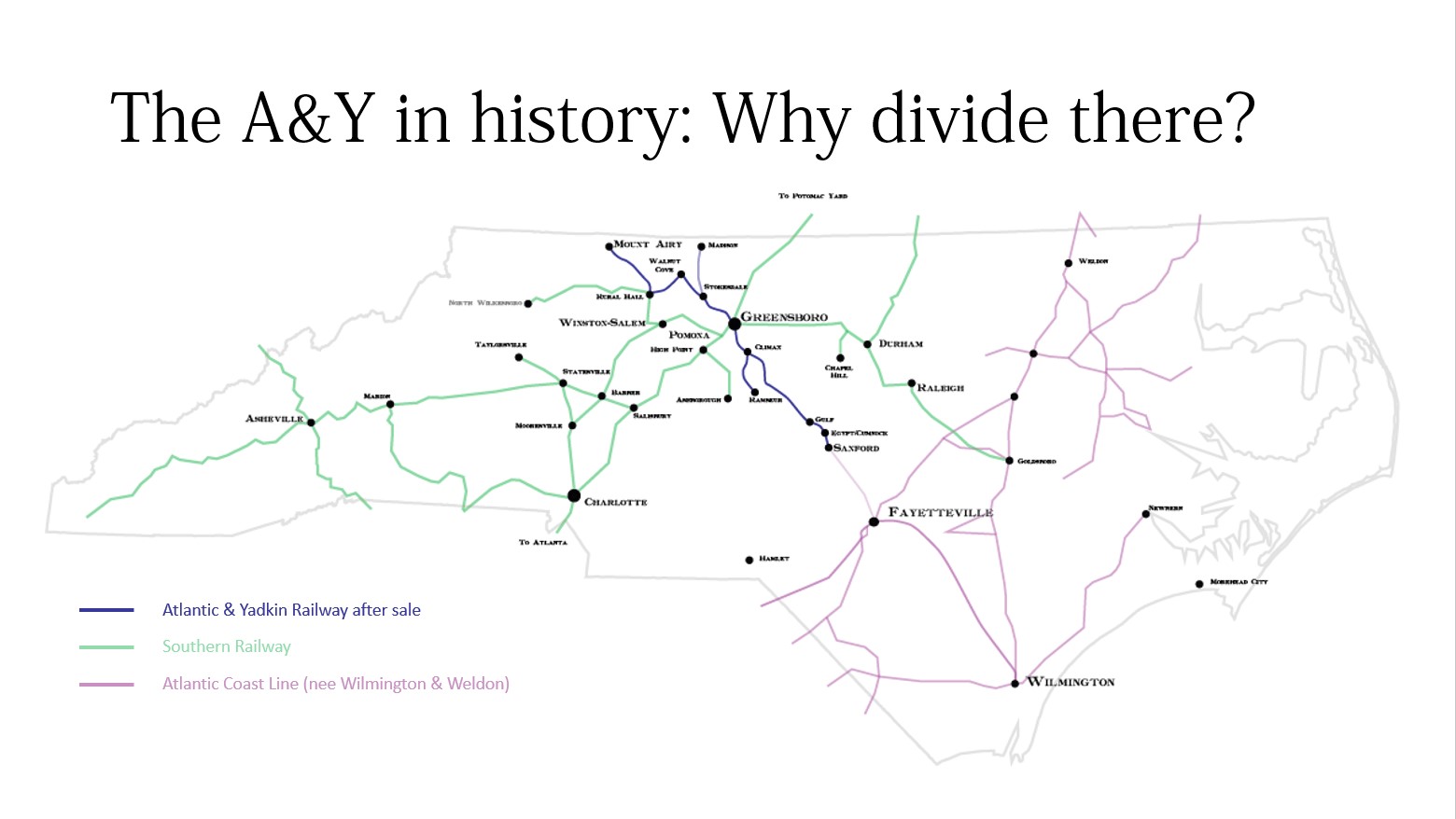
If you look at a map of the split and the connections with the two railroads that bid for the CF&YV, it is obvious why the split occurred in Sanford. North Carolina was effectively partitioned just like the railroad.
It could be wondered whether the creation of the Atlantic Coast Line as well as the A&Y was in part a response to the desire to form the A&Y and split the CF&YV in half. The owners of the Wilmington & Weldon would have felt the limitations of the charter and tried to remove them at some point regardless, but the sale and disposition of the CF&YV was clear motivation for the timing. If the NY Reorganization interests had prevailed, it is possible that a strong A Division could have resisted the aims of the W&W and changed the dynamics of North Carolina railroading considerably. The Southern and the ACL appear to have had a more respectful, even cordial relationship through the years, so it may be that a win-win for the two was also a strong outcome for the state as well.
Simultaneously with the split and the formation of the ACL, the A&Y’s entire capital stock was conveyed to the Southern Railway. The full legal and financial mechanics of this reorganization are documented in Chapter 9 of Samuel Spencer’s Legal History of the Southern Railway (1901), an internal history written immediately after the A&Y’s formation.
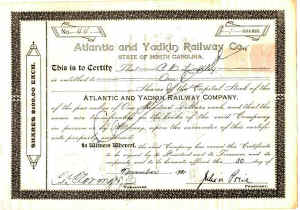
The Southern Railway thus assumed operations of all the track that remained with the A&Y and issued its own bonds on May 15, 1899. Those bonds were due April 1, 1949 — and that due date foreshadows the fate of the A&Y.
1899–1924 — Southern Railway Ownership
There were stakeholders in North Carolina who were not happy with the division of the CF&YV. In 1913, the North Carolina Corporation Commission investigated the CF&YV auction and division. Although a report was issued, it only covered findings of fact. Nothing happened legally again until 1922–23, when the NC legislature passed a joint resolution for the NC Attorney General to institute proceedings to dissolve the alleged illegal dismemberment of the CF&YV so that an east-west line could be restored. The Attorney General, James S. Manning, filed a complaint in 1923. The ACL filed a demurral — essentially arguing that the case should be dismissed because there was no legal basis even if the facts were true. The presiding judge sustained the demurral on February 8, 1924, on the grounds that the ACL and A&Y charters gave express authority for the actions taken. This was appealed to the NC Supreme Court but the original ruling was upheld. The legal debate was over.
When the Southern Railway assumed operations of the A&Y in 1899, it is unclear whether it was run like another division of the Southern or whether it was run as the A&Y. This may be a distinction without a difference. Given that the Southern Railway owned it wholly and was still new and searching for economies, it is unlikely that locomotives or rolling stock (even cabooses) would be lettered A&Y. A 1912 Southern Railway Track Chart describes the CF line as "A&Y Branch — Mt Airy to Sanford — Winston Salem Division." This coincides with the Southern operating the A&Y under a lease from 1908–1916. However, historian Roland B. Eutsler (writing in the 1925 North Carolina Historical Review) claims the A&Y "nominally operated itself" the rest of the time, up to the 1924 bankruptcy.
There are references in correspondence between executives of the Southern Railway and the Atlantic & Yadkin to lease agreements dating back to 1916, covering A&Y use and maintenance of locomotives and cabooses owned by the Southern. The early lease agreements themselves have not surfaced in available sources — only amendments made after the A&Y was under receivership and the mingled properties, operations, and expenses were more formally divided.
1924–1929 — Receivership
Whatever the precise operational status of the A&Y, by 1924 it was running in the red and declared bankrupt. From 1900 to 1908 the Southern had run the lines as part of its regular operations — a 1906 Southern Railway "Mileage-Operating Divisions" booklet lists the A&Y lines as part of the Danville Division. From 1908 to 1916, the Southern operated the A&Y lines under a lease. The USRA operated the lines in at least 1918 and 1919. And from 1924 to 1929, the A&Y was operated by receivers.
After the receivership, the A&Y made profits during the Great Depression and became a railroad that showed resilience with competent operators and capable leadership. The only thing threatening this bubble was the original bonds’ due date.
At that point, some of the A&Y’s tracks were those laid down in the nineteenth century as part of the Cape Fear & Yadkin Valley Railway. Some of those tracks are still in use today as parts of the Yadkin Valley Railroad and the Norfolk Southern.
1929–1950 — Independent Operations and the End of the A&Y
After the A&Y emerged from receivership, the Southern left it to operate independently — for reasons still unclear. Perhaps the worries of people in Greensboro that the Southern would have less competition kept the operations nominally, if not legally, separate.
When the bonds for purchasing the A&Y came due, the Southern management — already trying to simplify the tangled corporate and financial structures resulting from its own origin and aggressive growth — decided it was now appropriate to merge the A&Y completely into the Winston-Salem Division. With passenger service ended in the 1930s, most travelers were not worried about reduced railroad competition in the region. So the merger was accomplished in short order and relatively smoothly, with only some trepidation and complaints from Greensboro shippers at hearings held by the ICC. On January 1, 1950, the A&Y ended its existence and the properties, equipment, and employees became part of the Southern Railway’s Winston-Salem Division.
The A&Y did not own revenue cars, and its locomotives were primarily leased from the Southern. Much of the line from Rural Hall to Greensboro became redundant after absorption and those tracks were mothballed and eventually removed in the 1980s. The line from Mount Airy to Rural Hall remains intact and is now part of the Yadkin Valley Railroad, which also operates parts of the former Southern Railway K line to North Wilkesboro. The line from Gulf to Sanford was eventually sold to the Atlantic & Western Railway, the rest kept and operated by the Southern and, after the merger with the Norfolk & Western in 1982, the Norfolk Southern. A tie plant at Bonlee is probably the main reason for this.
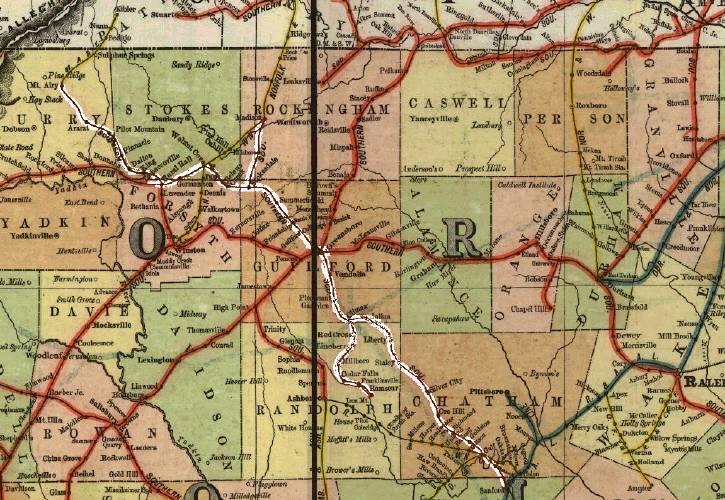
A&Y System Map, c. 1900
Derived from a 1900 map of North Carolina Railroads, I modified the lines representing the A&Y to white to provide a contemporary visual of the railroad. The redundancy of lines with the Southern Railway (depicted in red outline here) is well illustrated. The escarpment in the upper left, depicted in dark gray and black, represents a physical barrier to the promoters’ dreams of a line to the Ohio! The prominence of the Southern’s market in this part of the state, relative to other railroads, explains why the CF&YV’s northern half was acquired by the Southern. The scale of the map, however, hides the lives of people who worked around and for the A&Y during its ‘bubble’ of history. Those people are long gone, and talking to their descendants and learning their stories is much harder than accessing the legal and physical history of the railroad.
Author’s Note
History is always a work in progress. New evidence is found, interpreted, and reported; sometimes even requiring reinterpretation. The history of the A&Y is no exception. Despite publishing an article with Kevin in 2009, these pages are more like you watching me write in real time. Even after the basic story is crafted, I will be tinkering and rewriting as I have time. I err on the side of sharing a nearly rough draft state in the hope you find it useful and maybe even inspiring to suggest improvement. I’m using an AI tool to help reformat the web pages and the content. Let me know what you think of how I divided the history into era-specific pages with historical maps and some original sources. I am happy to hear how I can make the content and the format better, so please reach out!