The Cape Fear & Yadkin Valley Railway
A new name, a grander plan, and track finally moving north
Merger and Reorganization
By 1879, the Western Railroad had languished for nearly three decades — chartered in 1852, extended to Fayetteville for the coal trade, granted authority to push north in 1867, and yet frozen in place by the compounded financial crises of the Civil War and Reconstruction. A new approach was needed.
The solution came through consolidation. The Western Railroad merged with the Mount Airy & Ore Knob Railroad, a short line serving the granite and copper mining district at the northern end of the projected route, to form the Cape Fear & Yadkin Valley Railway. The new corporate identity brought with it reorganized finances, a refreshed charter, and — critically — the political will to begin actual construction northward.
The name itself signaled the ambition: the Cape Fear River at Fayetteville on the south, the Yadkin Valley in the piedmont foothills on the north. The CF&YV’s plan was to connect those two geographic anchors with a continuous line running through Sanford, Greensboro, and on toward Mount Airy — a route that would eventually span the length of the state’s piedmont.
Fraud, Courts, and Fourteen Years of Paralysis
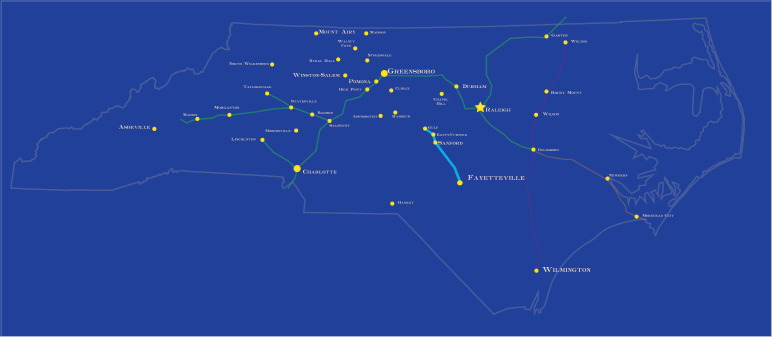
The physical challenges of building north through the Piedmont were real — grades, river crossings, terrain that demanded engineering and capital. But those were not the main obstacle. For fourteen years after the Civil War, the Western Railroad’s northward extension was strangled not by geography but by a fraudulent bond scheme, the litigation it generated, and a running battle between the state government and the private stockholders over who actually controlled the company.
In 1870, to finance the planned extension from Cumnock to a connection with the North Carolina Railroad near Greensboro, the Western Railroad executed a mortgage and issued $900,000 in 8% bonds, which were sent to New York to be negotiated. Only $5,000 of those bonds — purchased by a creditor named W.H. Howell — ever reached legitimate holders. The disposition of the remaining $895,000 became the subject of charges of fraud and years of recrimination. The stockholders repudiated the entire bond issue in 1872. Howell sued. The case traveled all the way to the U.S. Supreme Court, which ultimately held the mortgage invalid except as security for Howell’s modest claim. The fraudulent bonds sat in legal limbo for years before being formally destroyed in 1879. In the words of the railroad’s own legal history, the episode "delayed the prosecution of construction of the line in the direction of Greensboro for seven years."
The question of who controlled the company’s board ran as a constant undercurrent through the same period. The state of North Carolina held a significant block of stock — acquired in exchange for the bond loans it had extended over the previous decade — and repeatedly sought to use that ownership to dictate the board’s composition and the railroad’s direction. The private stockholders resisted, and a series of legislative compromises through the 1860s and early 1870s left authority divided and contested. While the Howell litigation crawled through the courts, the company attempted to authorize new bonds and new construction; legislative acts in 1871, 1873, and 1875 each tried to resolve the legal tangle, and each fell short of actually putting graders on the ground.
By 1877 the state had grown impatient with its stagnant investment. A new act declared that the State’s ownership made completion of the extension "of prime importance" for developing the region’s mineral resources, and authorized 100 convicts to be put to work north of Cumnock — their labor credited against bonds the company owed the state. That intervention produced the only tangible northward construction in fourteen years of effort: by early 1879, three miles of track had been laid, opening the line across the Deep River from Cumnock to Gulf.
Three miles. That was the sum of northward progress from the end of the Civil War to the formation of the CF&YV. The 1879 reorganization was not a clean starting point — it was first a clearing of wreckage. The fraudulent bonds were formally destroyed, the old mortgage settled, the state’s interest restructured from creditor to stockholder on defined terms. Only then could construction begin in earnest.
The Mount Airy & Ore Knob Connection
The Mount Airy & Ore Knob Railroad that merged into the CF&YV was itself a small but strategically significant property. It served the copper mining operations at Ore Knob in Ashe County and the granite quarrying district around Mount Airy — the same Surry County stone that would later make Mount Airy the "Granite City" and supply building material for projects across the eastern United States.
Bringing this northern anchor into the CF&YV consolidation gave the new railroad a southern terminal at Fayetteville and a northern terminal at Mount Airy, with the middle section to fill in between. On paper those were the endpoints — but the men who promoted the CF&YV were thinking further still: Wilmington on the Atlantic coast as the true southeastern terminus, and connections beyond Mount Airy reaching into the Ohio Valley. Where reality stopped short of that vision, and by how much, would define the CF&YV’s history.
The Other Direction: Fayetteville to Bennettsville
The Ohio River was a grand aspiration, but the CF&YV’s promoters were also eyeing a far more attainable opportunity in the opposite direction. Even as the 1879 reorganization fixed northern construction as the headline goal, plans were quietly taking shape for an extension southward from Fayetteville across the state line to Bennettsville, South Carolina — a market town in the heart of the Pee Dee tobacco and cotton country.
Where the northward line demanded difficult grades, long distances, and uncertain traffic, the Bennettsville branch offered shorter mileage, level terrain, and a ready agricultural freight base. Construction south of Fayetteville was authorized alongside the northern push, and the branch reached Bennettsville in 1884, operated through a South Carolina subsidiary known as the South Carolina Pacific Railway. At 57 miles it was a fraction of the main line’s ambitions — and it earned its keep far more reliably.
The branch’s profitability would take on unexpected importance when the Panic of 1893 drove the CF&YV into receivership. The question of who owned what — and who owed what to whom — mapped uncomfortably onto which parts of the railroad actually earned money and which did not. How the CF&YV’s properties were ultimately divided, and what emerged from that division, is a story for later chapters — but it has its roots here, in the simple fact that the Bennettsville branch paid its way when the rest of the system struggled to do so.
The System as Planned
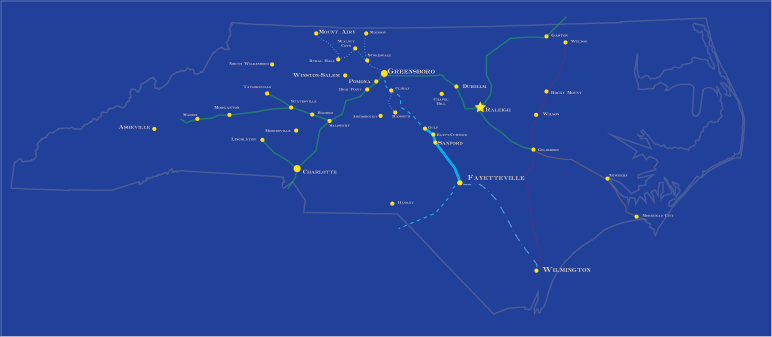
The CF&YV’s own promotional map, published during the construction era, shows the railroad as its promoters imagined it — and as it was partly built. The projected extension northwest beyond Mount Airy toward a connection with the Norfolk & Western, and the grand through route from Wilmington on the Atlantic to the Ohio Valley, are shown as clearly intended. The gap between that vision and what was actually completed by 1890 is itself a piece of the story.
