Rule Book · 1899
If an employee timetable told a crew when and where to run, the rule book told them how. Every train movement, signal response, meet procedure, and emergency action was governed by the rule book. Crew members were expected to know it; inspectors tested them on it. The rule book was a more static document compared to timetables. It was the foundation on which the timetable operated.
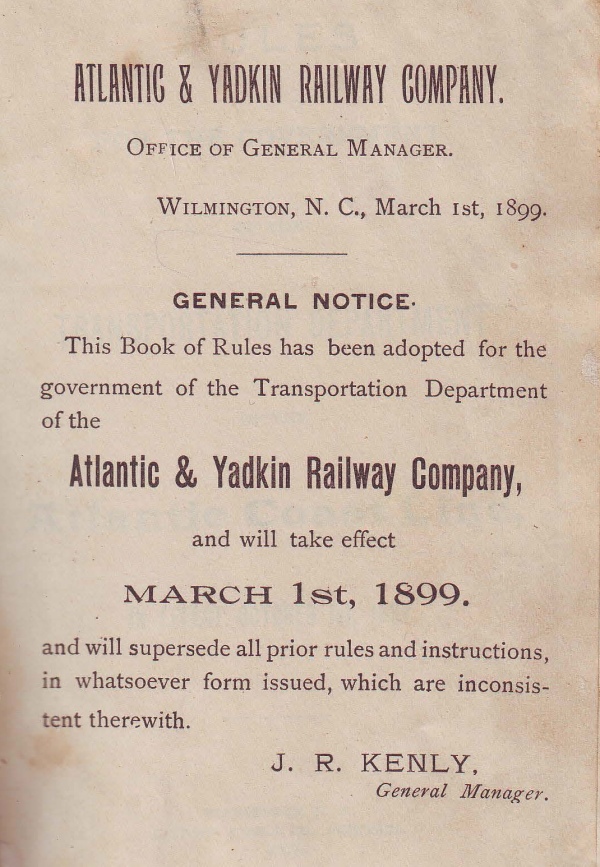
The A&Y rule book shown here is dated 1899 — the railroad’s first year of existence. It was almost certainly drawn from established practice rather than written from scratch. The railroad continued to operate while the sale, financing and organization of the road was happening. Given the twist where the Atlantic Coast Line (nee Wilmington & Weldon) purchased the CF&YV, then renamed it and sold it to the Southern, it is unclear whether the W&W or Southern or the CF&YV practices were the basis.
One detail on the title page is worth noting: the Office of the General Manager is listed in Wilmington, not Greensboro. In 1899 the Atlantic Coast Line, which had reorganized the CF&YV into the A&Y, still held effective control. Wilmington was ACL territory. By the time the Southern Railway began operating the A&Y, the management had moved to Greensboro. The Wilmington address in this rule book is a fleeting but telling marker of who was actually in charge at the beginning.
Click to open.
The full 71-page book is available as a PDF scan. The file has been reduced from the original scan resolution to keep the download size manageable for the web; allow a moment for it to load.
The book covers the standard subjects of late-19th-century railroad operating rules: train orders and their handling, right-of-way between trains, signals and their meanings, duties of conductors and engineers, speed restrictions, meeting and passing procedures, and the handling of equipment failures and emergencies. Together with the Employee Timetables and the train order forms, it helps illustrate how train movements on the A&Y were authorized, scheduled, and conducted.
I scanned this book graciously loaned to me by Kevin von der Lippe and the Greensboro Chapter of the National Railway Historical Society. It is considered to be in the public domain.
Selected rules
Most visitors won’t download a 71-page PDF. A few passages are worth pausing on — they give a quick sense of what operating a railroad in 1899 actually required of the people who worked it.
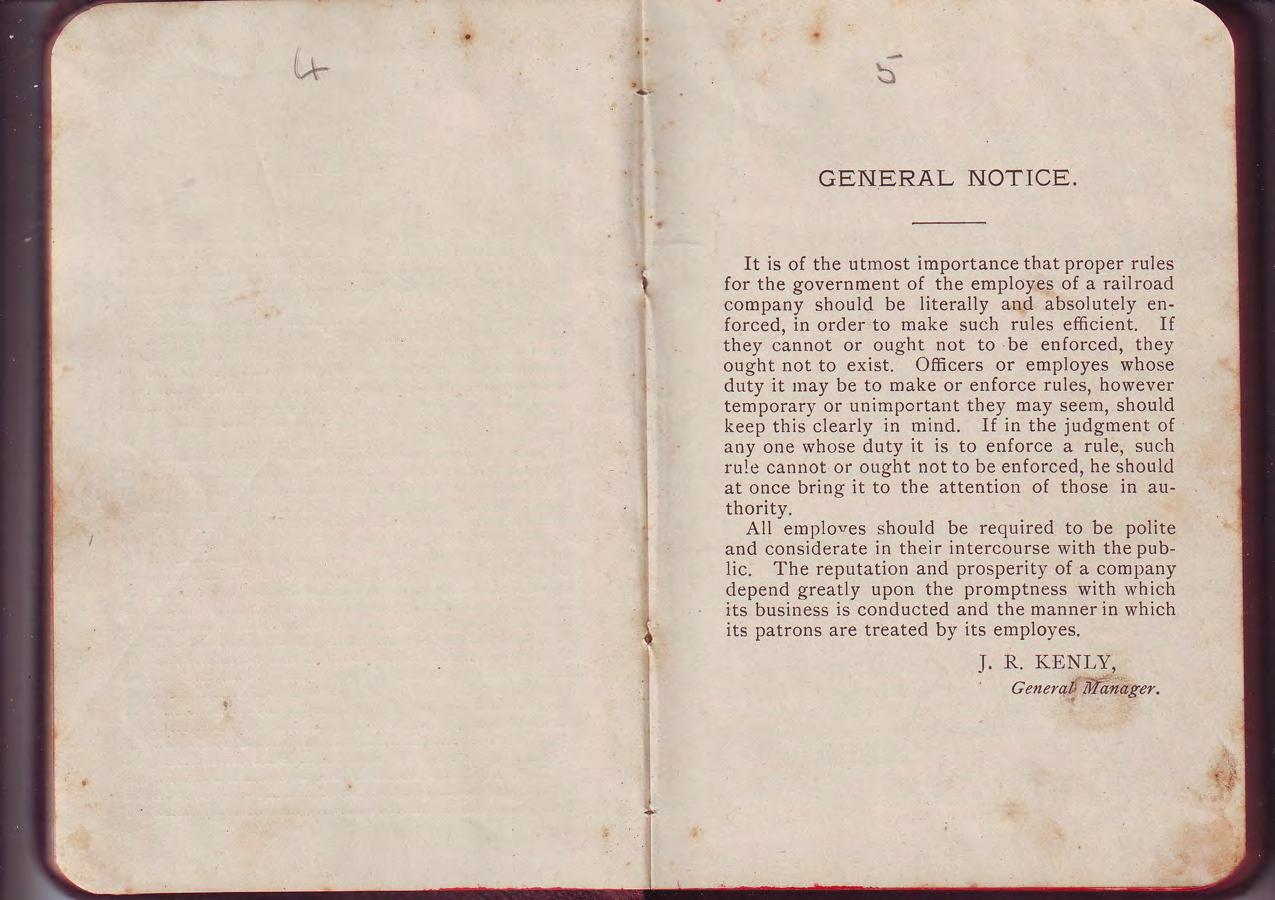
Kenly — writing from Wilmington — is not asking for flexibility. The rules exist to be followed; if a rule cannot be enforced it should be removed, not quietly ignored. The same notice asks that employees be "polite and considerate" with the public: "the reputation and prosperity of a company depend greatly upon the promptness with which its business is conducted and the manner in which its employes treat the public." Safety and customer service in the same paragraph, 1899.
Every blast of the locomotive whistle meant something specific. Enginemen were required to know these codes; so were the trainmen who had to respond to them.
| Signal | Meaning |
|---|---|
| — (one long) | Approaching stations, crossings, and junctions |
| · (one short) | Apply the brakes — stop |
| —— (two long) | Release the brakes |
| ·· (two short) | Answer to any signal except "train parted" |
| — — — (three long) | Flagman: protect the front of the train |
| · · · (three short, standing) | Train will back |
| — — — — (four long) | Call in flagman from west or south |
| · · · · · (five short) | Flagman: go back and protect rear of train |
| Rapid short blasts | Alarm — persons or cattle on the track |
Rule 50 — the rapid short blasts for persons or cattle on the track — is a reminder of what single-track railroading through rural North Carolina looked like day to day.
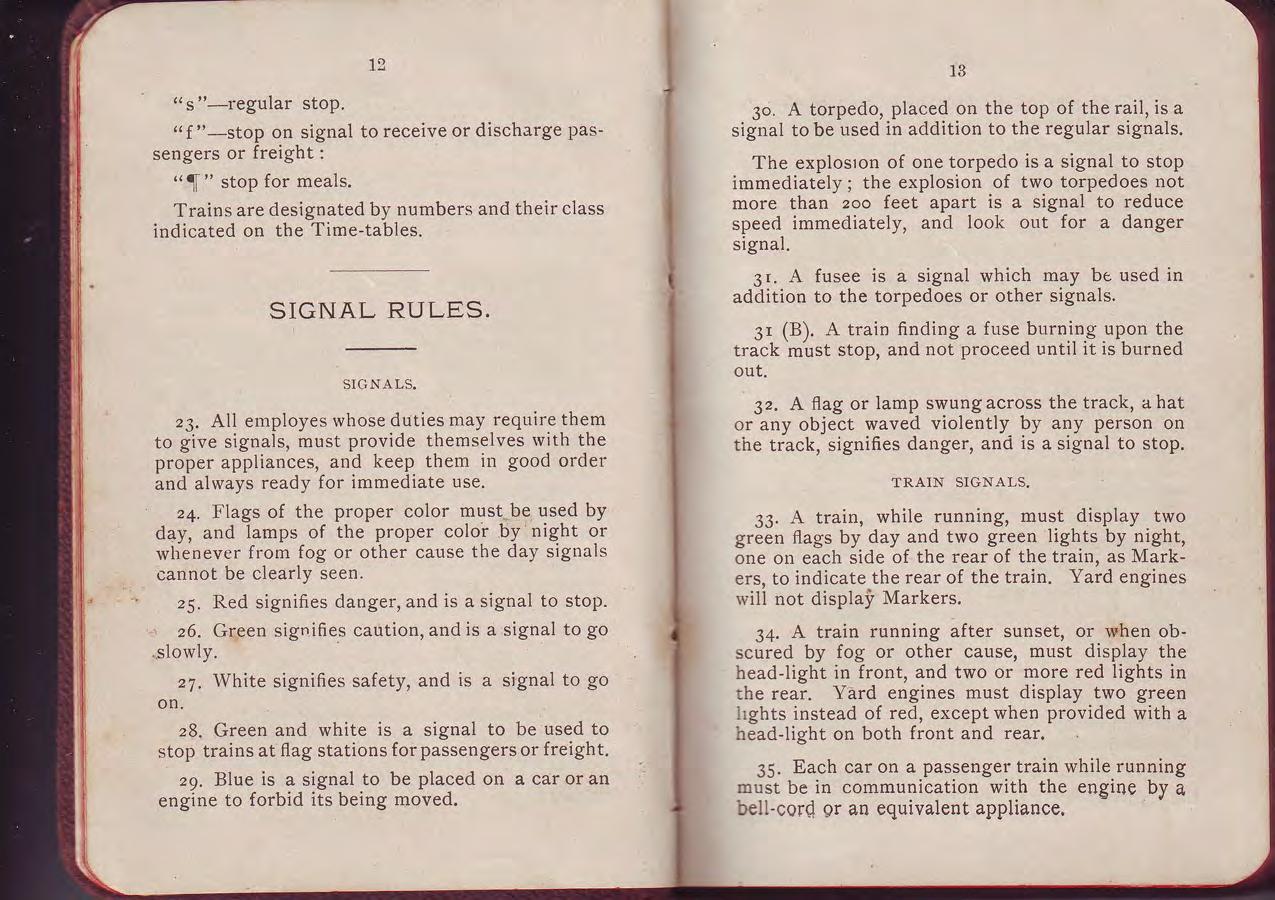
Before radio, before telephone, trains communicated with flags and lamps. The color code was simple but exact:
| Color | Meaning |
|---|---|
| Red | Danger — stop |
| Green | Caution — go slowly |
| White | Safety — proceed |
| Green & white | Stop at flag stations only |
| Blue (flag or light) | Workmen under or about equipment — do not move |
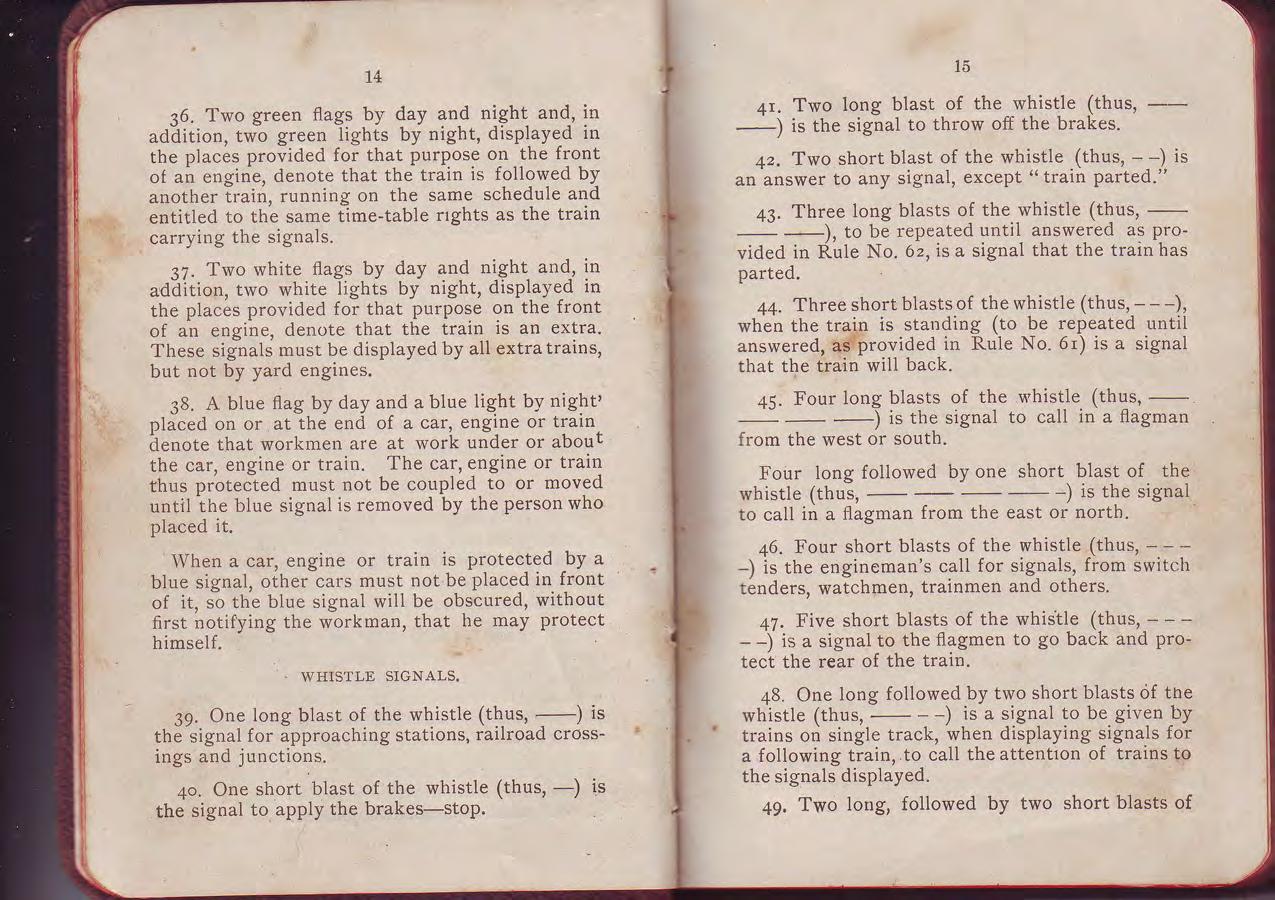
The blue flag rule (Rule 38) is worth noting: a blue flag on or at the end of a car meant workmen were under it. That car "must not be coupled to or moved until the blue signal is removed by the person who placed it." Only the worker who set the flag could take it down.
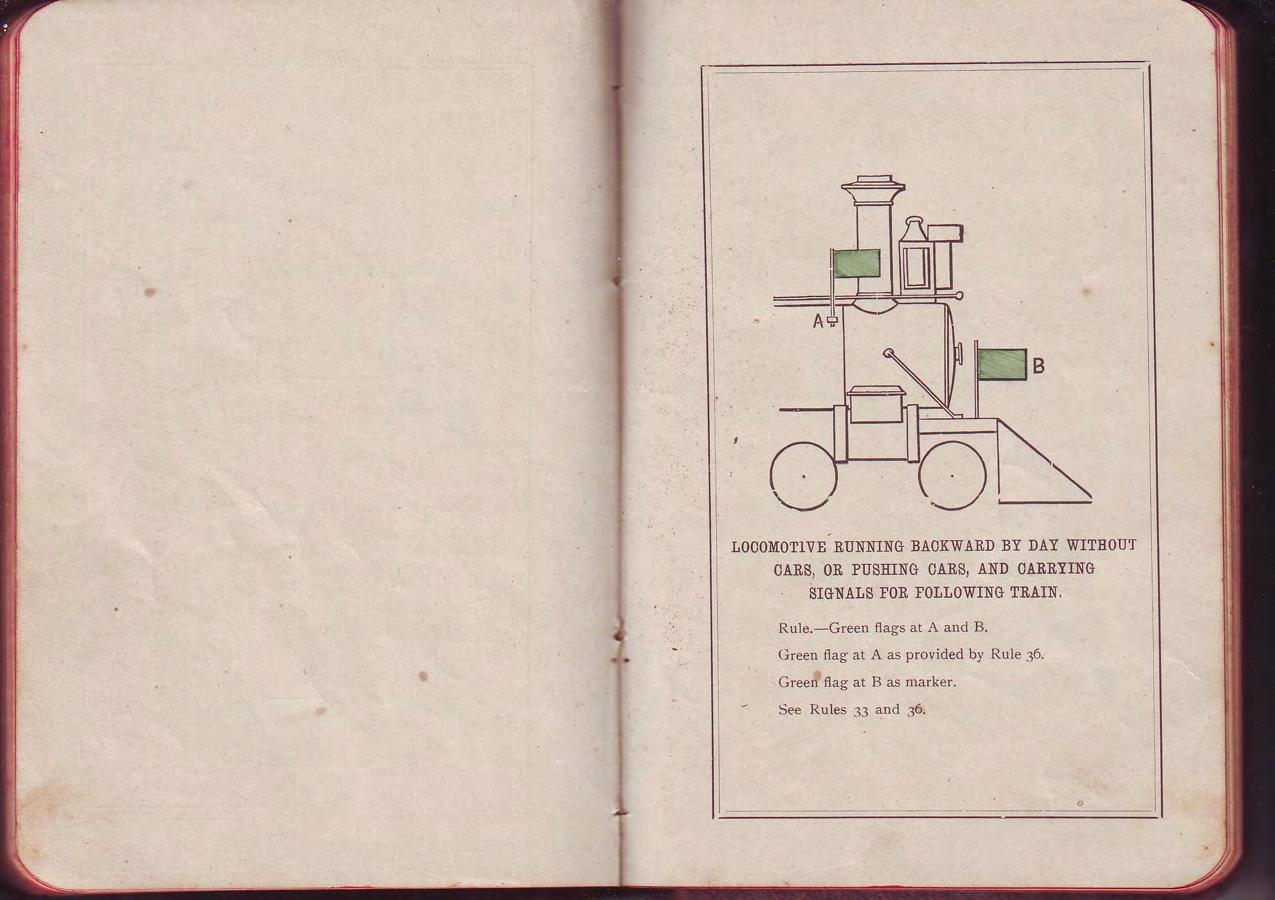
Two green flags on the front of an engine meant a second train was following on the same schedule. Two white flags meant the train was running extra — not on the timetable. Crews approaching a station would know from a distance what kind of train they were looking at.
The back of the book is given over to illustrated diagrams showing exactly how signals were to be displayed — which lights and flags go where, in what positions, for which type of train movement. Each situation has its own page: train running at night, pushing cars, running backward, carrying signals for a following train.
These diagrams come from the American Railway Association’s Standard Code of Train Rules, adopted July 15, 1889 — the same national standard that governed railroads across the country. The A&Y was operating under the same signal discipline as railroads many times its size.
The locomotive silhouettes and light-position sketches are the closest thing to technical illustration in an otherwise text-heavy document. They are also the most demanding pages for a 19th-century trainman to memorize: every configuration has a different meaning, and confusion between them was not an option on a single-track railroad.