Employee Timetables
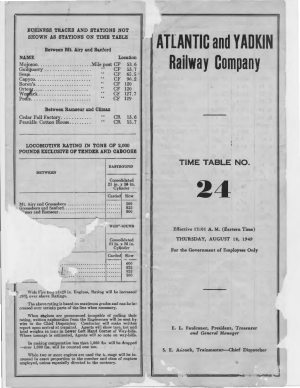
Employee timetables were crucial to the safe and efficient running of a railroad. Historic timetables are interesting for many reasons, but perhaps the most engaging aspect is that they are a tangible link between railroad operations and the hundreds of employees who worked to get the freight and passengers to their destinations safely and on time. They were issued to cover specific railroad divisions, or for short lines like the A&Y, the entire railroad. They provide a treasure trove of information besides freight and passenger train schedules, including listings of interlockings, stations, and rules specific to the division like speed and weight restrictions, locations of doctors on call, water stops (for the steam era), and special crossings. Over the years, more detailed information was added to them to reflect the growing complexity of rail transportation.
I have collected and scanned six A&Y ETTs spanning 1934 to 1949 — from near the midpoint of the A&Y’s independent existence to the year before dissolution. The 1934 ETT is currently the only one I have from the 1930s; if you hold an A&Y ETT from the 1920s or earlier 1930s, I would very much like to obtain an electronic copy — I’m a collector of the information, not the artifacts.
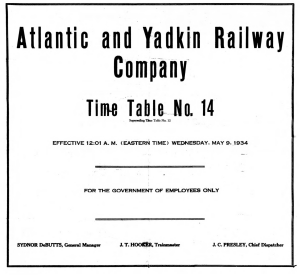
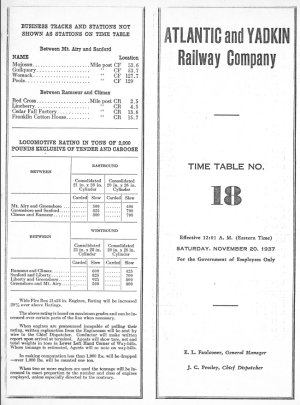
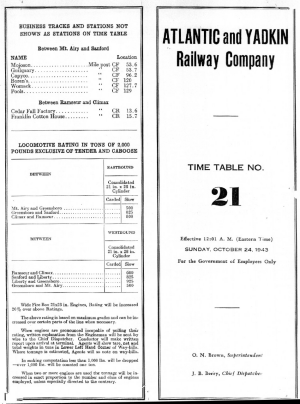

Southern Railway — Winston-Salem Division ETTs · 1934–1966
The A&Y was dissolved on January 1, 1950, and absorbed into Southern Railway’s Winston-Salem Division. The tracks did not change much, but the name did. The WS Division ETTs pick up where the A&Y ETTs leave off, covering the same physical plant under Southern ownership through 1966, when the Southern reorganized its divisions into larger groupings. Even then the rails didn’t change.
These documents matter to me for a reason that goes beyond operational continuity. Southern Railway conductor wheel reports from the WS Division, namely the Henry F. Snow conductor logs covering 215 trains from 1934 — are among the most useful sources next to waybills available for understanding what freight cars actually moved over A&Y rails. The WS ETTs provide the scheduled train context for those records. Together they help answer questions about car types, road names, and commodity flows that help me as a modeler as much as an historian. See the Freight Car Research page for how this analysis was used to determine a prototypical car fleet for modeling.
| ETT | Effective date | Division | Pages | |
|---|---|---|---|---|
| WS-48 | April 29, 1934 | Winston-Salem | 8 | Open ↗ |
| WS-59 | March 19, 1939 | Winston-Salem | 8 | Open ↗ |
| WS-76 | October 23, 1949 | Winston-Salem | 10 | Open ↗ |
| WS-77 | January 1, 1950 | Winston-Salem | 12 | Open ↗ |
| WS-78 | April 30, 1950 | Winston-Salem | 12 | Open ↗ |
| WS-79 | September 25, 1950 | Winston-Salem | 12 | Open ↗ |
| WS-80 | February 4, 1951 | Winston-Salem | 12 | Open ↗ |
| WS-81 | September 1, 1951 | Winston-Salem | 12 | Open ↗ |
| WS-82 | September 29, 1952 | Winston-Salem | 12 | Open ↗ |
| WS-86 | August 1, 1956 | Winston-Salem | 11 | Open ↗ |
| WS-93 | October 30, 1961 | Winston-Salem | 12 | Open ↗ |
| WS-96 | April 29, 1963 | Winston-Salem | 12 | Open ↗ |
| WS-98 | November 17, 1963 | Winston-Salem | 12 | Open ↗ |
| WS-99 | April 27, 1964 | Winston-Salem | 12 | Open ↗ |
| A-C-WS-38 | October 17, 1964 | Asheville–Charleston–W-S | 27 | Open ↗ |
| A-C-WS-40 | April 26, 1965 | Asheville–Charleston–W-S | 28 | Open ↗ |
| A-C-WS-43 | April 25, 1966 | Asheville–Charleston–W-S | 28 | Open ↗ |
Note: ETTs A-C-WS-38 through -43 reflect Southern’s 1964 reorganization merging the Winston-Salem Division with a larger territorial grouping. The former A&Y tracks appear in the Winston-Salem section of these combined timetables.