Modeling Steam Locomotives
Jo Modeling the steam locomotives of the Danville & WesternWhile there are a number of models which could be used as "good enough" stand-ins for the D&W locomotives, accurately modeling them is a bit of a challenge. Modeling the locomotives of the '30s and '40s, in either HO or N, is probably the easiest of all, as noted below.
| N | HO | O | G | |
|---|---|---|---|---|
| 1 | Atlas 2-6-0 * | B'mann Indy 2-6-0 | ||
| 2 | Atlas 2-6-0 * | |||
| 3 | Ken Kidder / FED 4-4-0 | B'mann Spectrum 4-4-0 ? | ||
| 4 | Atlas 2-6-0 * | |||
| 5 | Atlas 2-6-0 * | |||
| 6 | Atlas 2-6-0 * | |||
| 15 | Atlas 2-6-0 ? | Aristo-Craft 2-6-0 ? | B'mann Spectrum 2-6-0 ? | |
| 16 | ||||
| 17 | ||||
| 18 | ||||
| 19 | Roundhouse / Athearn 2-8-0 | Roundhouse / Athearn 2-8-0 | Delton / Aristo 2-8-0 ? | |
| 20 | B'mann low driver 4-6-0 | B'mann low driver 4-6-0 | B'mann Big Hauler / Annie ? | |
| 21 | Roundhouse / Athearn 2-8-0 | Roundhouse / Athearn 2-8-0 | Delton / Aristo 2-8-0 ? | |
| 22 | B'mann low driver 4-6-0 | B'mann low driver 4-6-0 | B'mann Big Hauler / Annie ? | |
| 23 | B'mann low driver 4-6-0 | B'mann low driver 4-6-0 | B'mann Big Hauler / Annie ? | |
| 24 | Roundhouse / Athearn 2-8-0 | Roundhouse / Athearn 2-8-0 | Delton / Aristo 2-8-0 ? | |
| 25 | Roundhouse / Athearn 2-8-0 | Roundhouse / Athearn 2-8-0 | Delton / Aristo 2-8-0 ? | |
| 77 | B'mann Spectrum 4-4-0 | B'mann Spectrum 4-4-0 | ||
| Minor detail work needed; some parts may need modification or relocation. | ||||
| Moderate kit bashing required; may have to fabricate or replace parts. | ||||
| Extreme kit bashing or scratch building required. | ||||
|
||||
Narrow Gauge
Modeling the D&W or its predecessors in the narrow gauge years is not going to be an easy task, especially in the smaller scales. If you can get the old Atlas models, TTn3 may be viable (although tiny!). In Fn3 (1:20.3) MyLargeScale.com ran a series a few years ago about building a Porter 2-6-0 based on the Bachmann Indy chassis, which would be fairly accurate for D&NR / D&W #1. There have been a variety of 3' gauge 4-4-0's in the popular scales, and one could presumably be kit bashed to represent #3, although I have not evaluated any specific models for the purpose. DM&Sw #1 / D&W #6, along with the rest of the engines in scales not mentioned above would be more of a challenge, and would probably involve a major kit bash or scratch build.
Top of page
#s 15-19
Numbers 15-18 are not much easier than the narrow gauge locomotives. Models of 19th century steam locomotives are relatively rare in any scale, and those that do exist are frequently out of scale, poor runners, expensive half century old brass, or any and all of the above. Number 19 is a little easier, since there are 2-8-0's in most scales which can be bashed without requiring a complete reconstruction. In HO and N, the Roundhouse 2-8-0 with its boiler lowered would be a very good starting point.
Top of page
#s 20-77
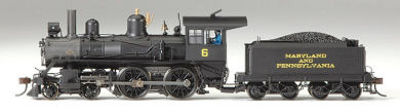
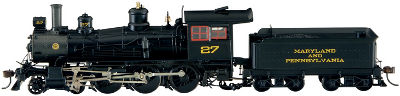
There are commercial models which (with a little work) could represent each of these locomotives. Refer to the prototype photos, of course. I will comment briefly on each locomotive, and what I think it would take to model it. All will need some level of detail work, but I leave that to the individual modeler to figure out, based on photos, personal taste and budget. Below are photos of the three best models for representing these locomotives. While these comments and photographs refer to the HO scale models, they are available in N scale as well, and can presumably be modified in a similar manner.
Bachmann Spectrum 4-4-0
Bachmann Spectrum low drivered 4-6-0
MDC/Roundhouse 2-8-0
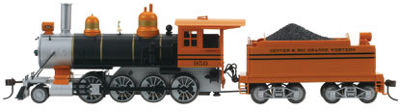
#s 20-24 will need new tender tops with a beaded edge. This could be made out of brass or styrene and glued in place. They (along with #25) will need steel cabs, which are also relatively simple to build. Finally, the stacks appear too tall on the models, and can easily be shortened. Below are notes specific to each individual locomotive.
#20
The only major changes needed are removing the valve gear (save it for #24) and raising the boiler. Replacing or modifying the counterweights does not seem to be practical without the use of a CNC mill. I am currently working on a this model, and have started a separate page for the kitbash here.
Top of page
#21
The only significant change needed is moving the sand box back. A wider firebox over the rear driver would also be appropriate.
Top of page
#s 22 & 23
See #20 for the basic work needed. In addition, the steam dome is the wrong style, and should be replaced or modified. Alco builder's plates could should be substituted for the Baldwin plates on the Spectrum model.
Top of page
#24
As with #21, the sand box beeds to be moved back, and the firebox widened. This model will also need valve gear, and that I leave to the individual to figure out the best way to model. If you can manage this and one of the ten wheelers at the same time, the Spectrum valve gear, rods, and cylinders will swap with relatively little modification. I am currently working on this along with my model of #20, and will have more to report in the future.
Top of page
#25
The domes are in roughly the right locations, although they are of the wrong style. As with #s 21 & 24, it needs a different firebox. Also, the drivers should have crescent counter weights. Another option would be to use the Model Power 2-8-0. While not the best quality, the overall look is quite close. I am considering using the Model Power boiler on a scratch built chassis, using Bachman 0-6-0 drivers because they are the correct diameter and have crescent counterweights.
Top of page
#77
This one is a little more difficult. To accurately represent #77, both drivers need to be moved back, and the rear set moved further from the front set. That means new rods all around. The boiler needs a section taken out of the rear, and added to the front, and that may cause clearance issues with the motor. Below is a photo-bash I did, showing the changes. The stock model is on top, the modified version on the bottom, and the modified version overlaid with a scale drawing in the center. The only change I made, other than noted above, was to bring the tender forward slightly.
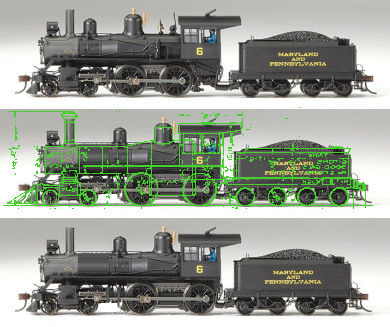
I have not looked at the Spectrum 4-4-0, but it appears to share its design quite closely with the 4-6-0. If that is the case, moving the drivers around should be relatively simple. It might involve a new frame, or modifying the stock frame, but the design of the chassis makes that remarkably easy to do without too much hassle.
Top of page