Models of 19th century steam locomotives are relatively rare in any
scale, and those that do exist are frequently out of scale, poor
runners, expensive half century old brass, or any and all of the
above. For that reason, modeling #s 15-19 would require scratch
building, heavy kit bashing, or simply accepting a generic "good
enough" model.
#15
There have been a handful of 2-6-0 models made, usually in brass, and
one would work if you can find it and get it running. That I
leave to
the individual, as the field is so wide, and there is nothing currently
on the market that comes close. HO indexTop of page
#s 16-18
It might be possible to
stretch a Bachmann old-time 4-4-0 into a tolerable 4-6-0, but the work
involved may make scratch building the better option. The old
Tyco/Mantua 4-6-0 is probably the closest commercial model. It is
too large
(1/76 instead of 1/87), but it has the right general look. HO indexTop of page
#19
The Roundhouse 2-8-0 could be back dated, and is as good as anything
else at this point. Without more information about #19, it is
impossible to give a better suggestion. HO indexTop of page
That leaves #s 20-25, and #77. There are commercial models which
(with a little work) could represent each of these locomotives.
Refer to the prototype photos, of course. I will comment briefly
on each locomotive, and what I think it would take to model it.
All will need some level of detail work, but I leave that to the
individual modeler to figure out, based on photos, personal taste and
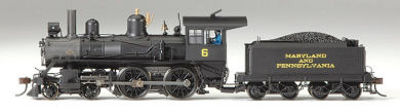
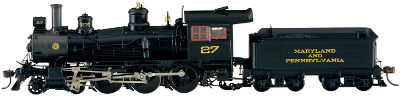
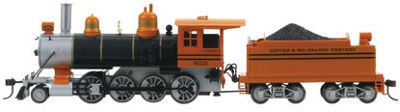
budget. Below are photos of the three best models for
representing these
locomotives.
#s 20-24 will need new tender tops with a beaded edge. This could
be made out of brass or styrene and glued in place. They (along
with #25) will need steel cabs, which are also relatively simple to
build. Finally, the stacks appear too tall on the models, and can
easily be shortened. Below are notes specific to each individual
locomotive.
#20 - Spectrum 4-6-0.
The only major change needed is
removing the valve gear (save it for #24). Replacing or modifying
the counterweights does not seem to be practical without the use of a
CNC mill. I am currently (July 2011) working on a this model, and
will have a better idea what is involved when the bash is finished. HO indexTop of page
#21 - Roundhouse 2-8-0
The only significant change needed is moving the sand
box back. A wider firebox over the rear driver would also be
appropriate. HO indexTop of page
#s 22 & 23 - Spectrum 4-6-0
As with #20, the valve gear needs to come off. The steam dome is
the wrong style, and should be replaced. HO indexTop of page
#24 - Roundhouse 2-8-0
As with #21, the sand box beeds to be moved back, and the firebox
widened. This model will also need valve gear, and that I leave
to the individual to figure out the best way to model. If you can
manage this and one of the ten wheelers at the same time, the Spectrum
valve gear, rods, and cylinders will swap with relatively little
modification. I am currently (July 2011) working on this along
with my model of #20, and will have more to report in the future. HO indexTop of page
#25 - Roundhouse 2-8-0
The domes are in roughly the right locations, although they are of the
wrong style. As with #s 21 & 24, it needs a different
firebox. Also, the drivers should have crescent counter weights. HO indexTop of page
#77 - Spectrum 4-4-0
This one is a little more difficult. To accurately represent #77,
both drivers need to be moved back, and the rear set moved further from
the front set. That means new rods all around. The boiler
needs a section taken out of the rear, and added to the front, and that
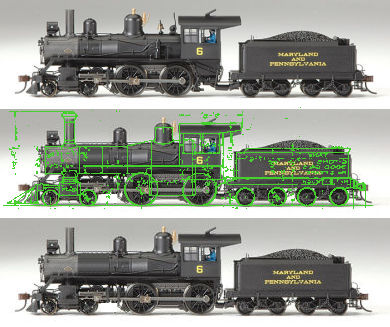
may cause clearance issues with the motor. Below is a photo-bash
I did, showing the changes. The stock model is on top, the
modified version on the bottom, and the modified version overlaid with
a scale drawing in the center. The only change I made, other than
noted above, was to bring the tender forward slightly. I
have not looked at the Spectrum 4-4-0, but I assume that it shares its
design with the 4-6-0. If that is the case, moving the drivers
around should be relatively simple. It might involve a new frame,
or modifying the stock frame, but the design of the chassis makes that
remarkably easy to do without too much hassle. HO indexTop of page
N Scale
#s 15-19
The same general coments about the HO scale models apply here. I
will add that such small N scale locomotives are few and far between,
and those with the skill and patience to build such a model probably do
not need my advice!
#s 20-77
Since the Bachmann and Roundhouse models are available in N as well as
HO, the
same general comments apply. I cannot comment on the difficulty
or practicality of the projects, but neither can I comment on any
better options. I suspect that the bashes would be slightly more
difficult, especially in the case of #77, but hopefully within reason. Top of
page
Decals
There are no decals available for D&W locomotives, but the
lettering is simple enough that it could be done with a white Railroad
Roman alphabet and number set. Under the cab window, there was a
small "DANVILLE & WESTERN" and below that the road number.
The number also appeared on the sand box, and centered on the tender
side. On the rear of the tender was (on the left) "D&W. ##"
with the tender water capacity on the upper right. The headlights
had number boards on the sides, which were white with black numners
(although many of the photos show them either blacked out, or so dirty
as to be illegible). Finally there was a circular number plate
centered on the smokebox front, which carried a cast number (presumably
polished brass on a black background). Top of
page